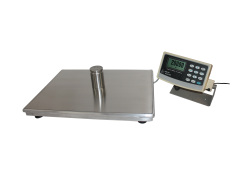
Livestock, Alpaca and Llama Scales with Weight Average and Hold
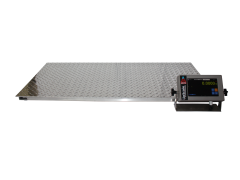
Starting at $864
In veterinary offices and zoos, health is the most important reason for weighing animals. Pets and animals in the zoo have certain weights at which they are most healthy. A veterinarian or animal handler in a zoo might make recommendations for caloric intake based on an animal’s weight.
It is also extremely important on farms to ensure that animals are kept healthy. Animals such as pigs, alpaca, and llama are major investments, and it is most economically viable for a farmer to make sure that his animals are healthy and infection-free. Weighing farm animals may alert a farmer to a sick animal if its weight is too low.
When a sick animal is found, medication must be administered. Since all animals from pets, to wild animals in the zoo, to farm animals, differ greatly in size, they cannot all be given the same dosage of medication. Weighing sick animals helps to choose a proper safe dosage that will help cure the animal.
Scales used with animals, such as electronic veterinary scales, and alpaca scales and llama scales, should be made with a very low profile. It is often difficult to get any animal, from an elephant to an alpaca to a dog, to step up onto a platform scale. The lower the profile, the quicker it will be to coax the animal onto the veterinary scale. Once on the platform scale, animals often will not stand still. This causes problems in weighing since the weight of the animal will shift onto and off of the platform, causing uncertainties in measurement.
Arlyn Scales has developed a solution to this problem called Weight Average and Hold. When an animal is loaded onto the veterinary scale, the doctor or animal handler presses a button. At this point, the electronic scale begins storing the measured weight continuously. It saves every reasonable weight point while throwing out any points that are out of a significant range from the average weight. Once a necessary number of weight points have been stored, these weights are averaged out and the final calculated weight is displayed.
Our products for all animals, pets, and livestock are made in the U.S.A. and are animal-friendly.
A standard veterinarian scale may have a capacity of 500 lb. The platform size should be large enough to weigh even the largest dogs. One typical size is 22 x 44. It is useful for the electronic scale to be able to display small weight increments. Generally, 1/10 of a pound is sufficient. This allows the animal scale to also be used for smaller animals, such as cats or puppies. For much smaller animals, such as birds, gerbils, and small reptiles, a scale with greater accuracy should be used. These smaller scales may have a capacity of 25 lb, and readability of 0.005 lb (better than 1/10 of an ounce). The platform size can also be smaller. In this case, it is 12 x 16. There are a number of special features that are useful for a veterinarian scale.
Read more about how, where, and when to use the right scale for animals:
Some of the most suitable precision scales are our line of Veterinary Scales for Livestock, Alpaca and Llamas, as well as sizes for veterinary offices. With 30 years in the business, we understand farmers’ and veterinarians’ dilemmas, and here we list some of our solutions for those who need to handle, sort, and weigh animals on a daily basis.
Scales are no doubt an integral part of most zoo operations. Scales help to alert zoo veterinarians of issues and potential diseases affecting the health of animals. The problem with many veterinary scales is that they may not offer the capacity to weigh large animals such as alpacas and llamas, which are staples at zoos … Continued
If you’re a pet-owner then you understand the importance of a skilled and experienced veterinarian. But did you know veterinarians are needed in more places than local animal hospitals and clinics? Veterinarians work with a variety of animals big and small. In addition to working with domesticated animals and treating them at animal hospitals and … Continued
Every time your canine friend visits the veterinarian, they will wind up on some sort of measuring tool to check their health. The balances most commonly used to weigh dogs nowadays have become indispensible tools, namely in this digital age. Vets weigh animals for a number of reasons. One of the factors vets usually check … Continued
Agriculture, the backbone of civilization, has become increasingly high-tech over the last century. Since the beginning of agricultural, some 10,000 years ago, producing foods and goods through the cultivation of crops, and pastoral herding of livestock has always relied heavily on the use of tools. Early agriculturalist employed simple irrigation systems, sickles and ploughs to … Continued
Like humans, domestic animals require medications when they fall ill. Since weight differences in animals can be as large as 700-fold, accurate weight information is necessary in determining the dosage needed by each specific animal. Like humans, domestic animals require medications when they fall ill. Since weight differences in animals can be as large as … Continued
You’re diligently looking for a small animals scale. You’re not just looking for any scale, however, you’re looking for a scale that is above average, extremely accurate and has great durability. You’ve come across scales that have been less than standard while on your search but now you’re looking for perfection. The great news is, … Continued
Many people are able to weigh their pets on a normal bathroom scale at home. However, for farmers and other agriculturists, the playing field changes. The animals that are found on farms are much larger than the pets that are found at home. A special type of scale, called livestock scales, has been designed to … Continued
Copyright © 2007-2026 Circuits & Systems Inc. Arlyn Scales. All Rights Reserved.