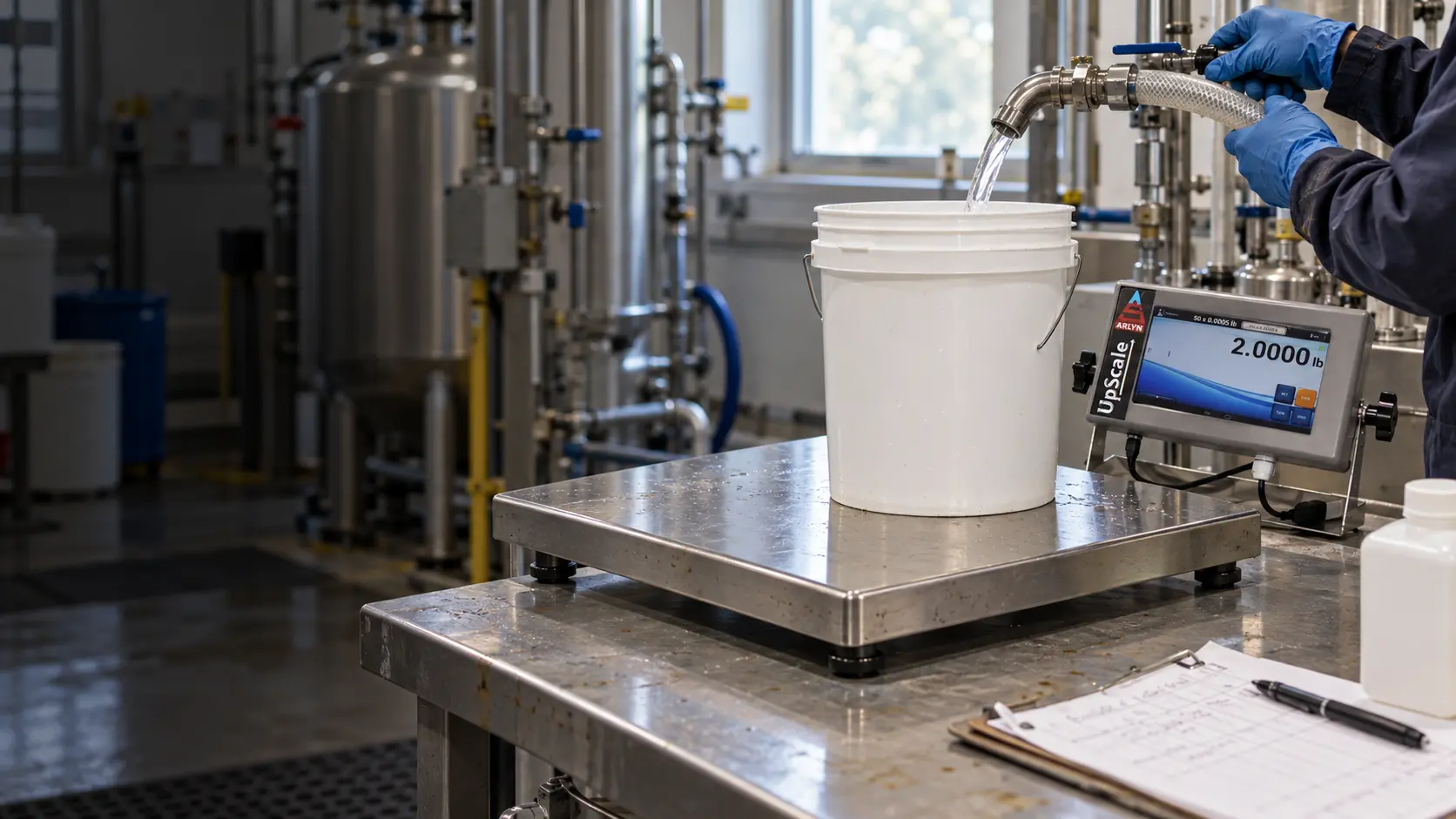
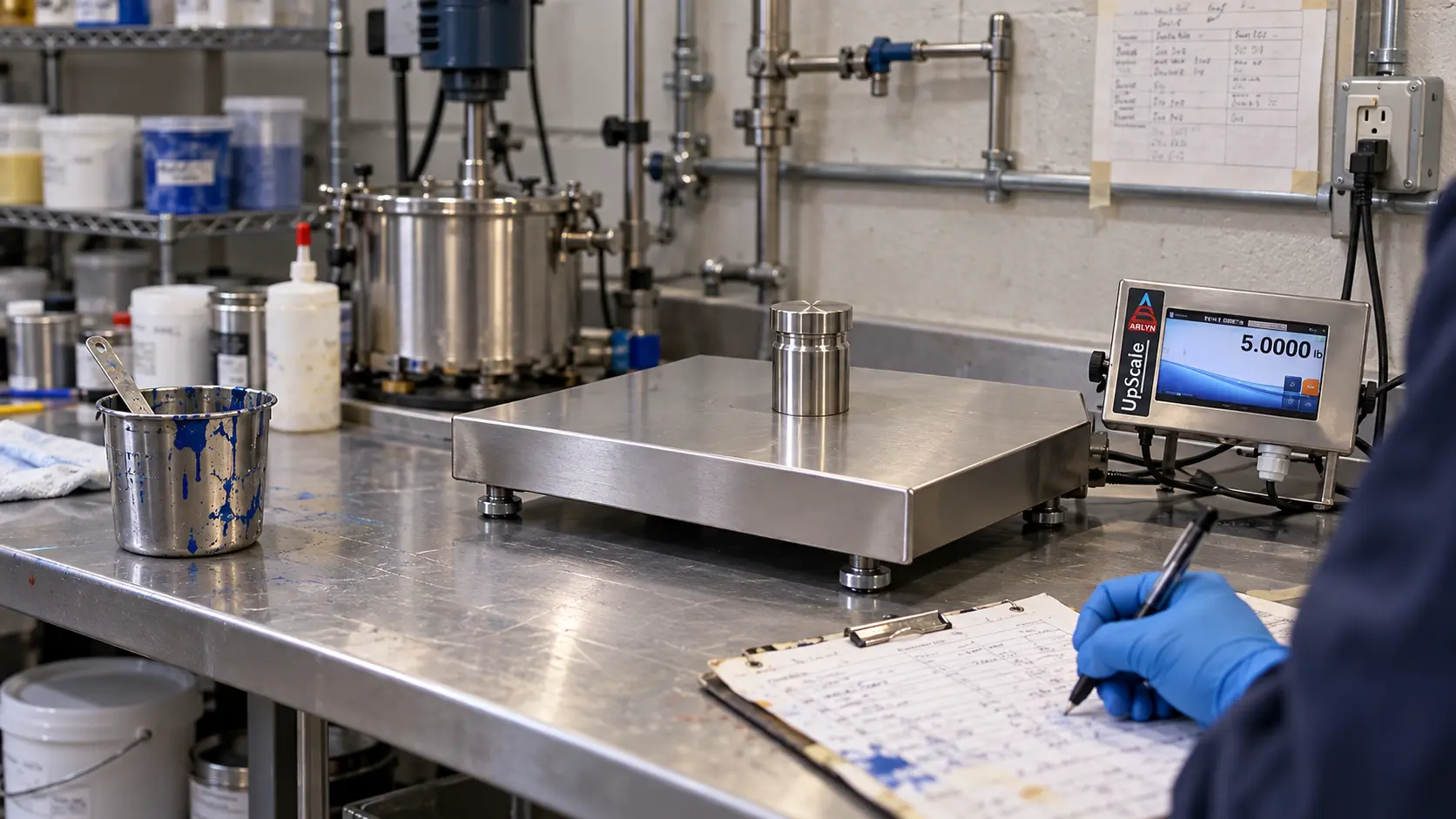
Industrial and chemical scales should match the complete load, required readability, material exposure, operating environment, and data workflow.
Arlyn offers standard industrial scales, Ultra Precision SAW systems, corrosion-resistant configurations, washdown and dustproof options, and ArlynGuard systems for hazardous classified locations.
Chemical weighing includes formulation, batching, dispensing, filling, inventory, and process monitoring. The right format may be a bench scale at a workstation, a low-profile drum scale, a platform or floor scale under a vessel, or a cylinder scale tracking gas inventory. Arlyn has designed and manufactured industrial weighing equipment in the United States since 1978.
Choose by process environment
The chemical itself does not determine whether a location is hazardous. Use the facility’s documented electrical area classification and select construction for the actual exposure and cleaning method.
Dedicated corrosion-resistant configurations use welded stainless steel, stainless load cells, and a three-part polyamine epoxy coating with garnet for abrasion resistance. These features belong to the applicable configuration and should not be assumed for every chemical scale.
Match the scale to the load and process
Capacity must cover the container, fixtures, and maximum contents. Tare displays net material weight but does not restore capacity used by the vessel. Platform size, loading access, and the required displayed increment then narrow the choice.
Bench scales handle ingredient containers, sampling, and workstation batches.
Drum scales, platform scales, and floor scales serve drums, totes, vessels, pallets, and bulk loads.
Cylinder scales monitor compressed or liquefied gas. A-TON is the specialized route for chlorine or sulfur dioxide ton containers.
High Resolution Balances are the secondary route for lower-capacity milligram or submilligram samples in controlled conditions.
Mechanical details affect the result. A drum moved by hand truck benefits from a low-profile platform and ramp. A connected vessel may introduce piping forces or require a fixed platform. A cylinder needs stable support suited to its footprint. These installation conditions should be considered with capacity and readability rather than treated as accessories after the scale is selected.
Ultra Precision for formulation and batching
Ultra Precision is the primary precision route when a chemical process needs fine readings at capacities or platform sizes beyond a typical laboratory balance. Surface Acoustic Wave systems cover bench and larger-platform work for formulation, filling, and loss-in-weight applications.
For hazardous classified locations, ArlynGuard provides bench, Ultra Precision, cylinder, drum, platform, floor, and specialized ton-scale routes. ArlynGuard T remains the specialized chlorine-ton option within that family.
Connect weight to the production workflow
With the appropriate indicator and options, an Arlyn scale can support serial, network, Web API, data-logging, setpoint, and selected industrial communication paths. Hazardous installations may use approved barriers or safe-area components. For material identification, an UpScale system with the Barcode & QR Print Function can send weight and process fields to the Arlyn PR-A90.
Frequently Asked Questions
What type of scale is used for weighing chemicals?
Chemical weighing can use an Ultra Precision scale, bench scale, drum scale, platform scale, floor scale, cylinder scale, chlorine ton scale, or a High Resolution Balance for lower-capacity controlled samples. The correct format depends on the complete load, required displayed increment, container, operating environment, and handling method.
How do I choose between a bench, drum, platform, floor, or cylinder scale?
Choose the format around the complete loaded weight, container footprint, and handling method. Bench scales suit workstation containers, drum scales support drum loading, platform and floor scales serve larger vessels or bulk loads, and cylinder scales provide stable support for compressed or liquefied gas inventory.
Are all chemical scales corrosion resistant?
No. Chemical application does not automatically make a scale corrosion resistant. Dedicated corrosion-resistant configurations use construction and protective treatments intended for aggressive materials. Exposure conditions and cleaning methods remain part of product selection.
What scale is used for chemicals in a hazardous location?
ArlynGuard systems provide intrinsically safe configurations for approved hazardous classified locations. The load format, handling method, and applicable approval documentation determine the appropriate bench, Ultra Precision, cylinder, drum, platform, floor-scale, or specialized ton-scale series.
Can a chemical scale send weight data to production software or a PLC?
Yes. An Arlyn scale equipped with the appropriate indicator and options can provide network, serial, Web API, logging, and selected industrial communication paths. UpScale supplies the touchscreen and workflow layer while the scale platform performs the measurement.
Discuss your industrial or chemical weighing application
Share the material, container or vessel, maximum loaded weight, required displayed increment, operating environment, and area classification when applicable. Arlyn can route the application to the appropriate standard product family or engineered weighing system.
Dirty environments are not beneficial for accurate measurements. Whether you work with the mud, or with waste, you want to ensure that nothing skews your measurements. Browse our array of dustproof and washdown scales to see which models are just right for you. We’ll ensure that your stainless steel construction is up to the task. … Continued
Electronic scales for cryogenic gases blend the best abilities of a gas scale with the technology and electronics of modern engineering. Electronic scales for cryogenic gases are similar to scales for liquefied gases. Both scales weigh the mass of the gases contained in cylinder structures. The purpose of electronic scales for cryogenic gases is to … Continued
Some commercial operations involve the use of aggressive acids or caustics that erode standard industrial scales. If you must weigh tanks, drums, chemicals, and other components in these environments, you require corrosion-resistant scales that are precise and reliable. To ensure that you find the best scale for your operations, you must understand the components required … Continued
The rubber, plastic, polymer, and artificial fiber manufacturing processes involve precise and accurate formulations. Natural rubber is heated with sulfur, peroxide, or bisphenol in the proper amounts to improve resistance and elasticity and to prevent it from disintegrating. Plastic is derived from oil constituent parts in the form of ethane and propane, which are then … Continued
Weighing liquids is a tricky business. When liquid sloshes around in its container it can cause scales to give inaccurate measurements. Liquid measurements require a scale that is extremely accurate and can measure quickly. Otherwise, you waste time and money by taking too long to take a reading when you are still not certain if … Continued