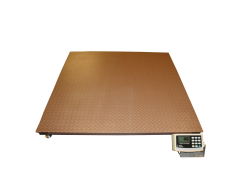
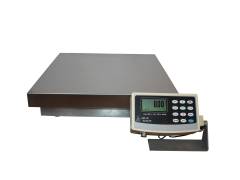
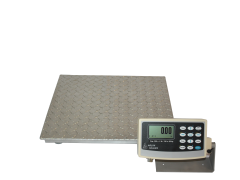
Weighing a large product requires more than selecting a scale with a high maximum capacity. The scale must also provide a platform large enough to support the load, suitable readability for the application, a practical loading method, and sufficient durability for regular industrial use.
Arlyn Scales offers two primary solutions for weighing large and heavy products:
- Series 5200 industrial floor scales for pallets, machinery, containers, bulk materials, and loads weighing thousands of pounds.
- Large Ultra Precision SAW scales for applications that require a large platform or higher capacity while still detecting very small changes in weight.
Choosing between these scale types depends on the total load, platform dimensions, required readability, loading equipment, operating environment, and data or automation requirements.
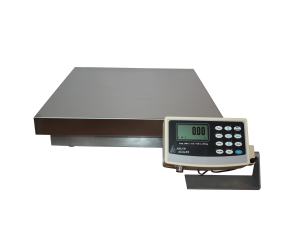
How Do You Weigh a Large or Heavy Product?
To weigh a large product, place the entire load on a platform scale that safely supports the product’s total weight and footprint. The product must not touch the floor, a wall, a conveyor, a pipe, or any surrounding structure while the scale takes the measurement.
For dependable results, the scale should provide:
- A maximum capacity greater than the heaviest expected load
- A platform that fully supports the product or its pallet
- Readability appropriate for the smallest important weight change
- A stable and level installation surface
- A safe method for loading and unloading the product
- Construction suitable for the operating environment
- Required outputs for computers, PLCs, printers, or data systems
Do not select a scale based on capacity alone. A 20,000-pound scale may support a very heavy load, but it will not provide the same fine readability as a scale designed for a 500-pound or 1,000-pound maximum load.
Which Scale Is Best for Weighing Your Large Product?
The correct scale depends on whether the main challenge is the product’s total weight, its physical dimensions, or the need to measure small weight changes.
| Application Requirement | Recommended Scale Type | Why It Fits |
|---|---|---|
| Pallets and containers weighing several thousand pounds | Series 5200 floor scale | Large platform, low-profile construction, and capacities up to 20,000 lb in listed models |
| Custom machinery or oversized assemblies | Custom Series 5200 floor scale | Custom platform dimensions and capacities can match the product footprint |
| A 200–1,000 lb product requiring very fine readability | Large Ultra Precision SAW scale | Combines industrial capacity with readability as fine as 0.002 lb |
| Bulk containers used for filling or dispensing | Floor scale or Large Ultra Precision scale | Selection depends on total weight and the smallest change the process must detect |
| Wet, corrosive, or washdown area | Stainless-steel floor-scale configuration | Provides greater resistance to moisture and corrosive materials |
| Hazardous or classified location | Properly approved intrinsically safe scale system | The scale and associated equipment must match the applicable location classification |
Series 5200 High-Capacity Floor Scales
Arlyn Series 5200 floor scales are designed for heavy-duty weighing in factories, warehouses, shipping departments, production areas, loading docks, and other industrial environments.
Standard listed models support capacities from 2,500 to 20,000 pounds. Custom platforms can be produced for capacities up to 30,000 pounds and for products that do not fit standard platform dimensions.
Available Series 5200 Capacities and Platform Sizes
| Capacity and Readability | Example Platform Sizes | Typical Applications |
|---|---|---|
| 2,500 lb × 0.5 lb | 3 × 3 ft or 4 × 4 ft | Small pallets, drums, bins, carts, and production containers |
| 5,000 lb × 1 lb | 3 × 3 ft, 4 × 4 ft, 5 × 5 ft, or 4 × 6 ft | Palletized products, bulk containers, machinery, and shipping applications |
| 10,000 lb × 2 lb | 4 × 4 ft, 5 × 7 ft, or 6 × 8 ft | Heavy assemblies, large containers, industrial equipment, and material handling |
| 20,000 lb × 5 lb | 4 × 4 ft, 5 × 7 ft, or 7 × 9 ft | Very heavy products, large machinery, process vessels, and bulk industrial loads |
| Custom configurations up to 30,000 lb | Custom platforms up to approximately 8 × 12 ft | Oversized products and application-specific weighing systems |
The best platform is not necessarily the largest one available. Choose a platform that supports the product safely while fitting the available floor space and loading method.
How Are Arlyn Floor Scales Protected from Heavy Industrial Use?
Large products are often loaded with forklifts, pallet jacks, cranes, carts, or other material-handling equipment. This creates a greater risk of impact, uneven loading, abrasion, and accidental overloading.
Arlyn Series 5200 floor scales address these conditions with:
- Four industrial-grade, heat-treated stainless-steel load cells
- Load cells mounted inside protective pockets within the scale frame
- Welded platform construction
- A zinc-rich epoxy coating for corrosion resistance on painted-steel models
- Optional full stainless-steel platform construction
- Adjustable leveling feet
- A separate, remotely mounted digital indicator
- Low-profile platforms that simplify loading and unloading
Why Use Four Load Cells?
A large floor-scale platform normally uses one load cell near each corner. The four sensors work together to measure the load across the platform.
This arrangement allows the platform to support large products and pallets while maintaining measurement performance across the usable weighing area. The product should still be positioned as evenly and consistently as the application permits.
Why Are Stainless-Steel Load Cells Important?
Stainless-steel load cells provide greater resistance to corrosion and industrial abuse than many lower-cost aluminum or plated-steel alternatives.
Arlyn machines and matches its floor-scale load cells at the factory. Matching the sensors allows the system to operate without the conventional external summation board used by many multi-load-cell scales, eliminating one potential source of failure.
Large Ultra Precision Scales for Heavy Products Requiring Fine Readability
Some products are too heavy or physically large for a laboratory balance but still require much finer measurements than a conventional floor scale can provide.
Arlyn’s Large Ultra Precision Scales use patented Surface Acoustic Wave technology to combine industrial capacity, larger platforms, and fine readability.
Standard Large Ultra Precision Models
| Model | Capacity and Readability | Platform Size |
|---|---|---|
| SAW-HL | 200 lb × 0.002 lb | 20 × 23 in |
| SAW-JL | 300 lb × 0.002 lb | 20 × 23 in |
| SAW-KL | 500 lb × 0.005 lb | 20 × 23 in |
| SAW-KXL | 500 lb × 0.005 lb | 31.5 × 31.5 in |
| SAW-MXL | 1,000 lb × 0.01 lb | 31.5 × 31.5 in |
How Does SAW Technology Improve Large-Product Weighing?
Surface Acoustic Wave technology converts small mechanical displacement into a frequency-based digital measurement. This allows an Ultra Precision scale to detect much smaller changes in weight than a typical industrial scale of similar capacity.
For example, a conventional 1,000-pound industrial scale may display in increments of approximately 0.2 pound. The SAW-MXL provides a readability of 0.01 pound, allowing it to detect substantially smaller weight changes.
Large Ultra Precision scales are especially useful for:
- High-value parts counting
- Chemical formulation and batching
- Filling and dispensing
- Flow-rate measurement
- Material-consumption monitoring
- Quality-control inspection
- Large laboratory samples or vessels
- Inventory monitoring by weight
These scales provide up to 10–20 times finer measurement performance than conventional industrial scales, depending on the model and comparison.
Standard Floor Scale Versus Large Ultra Precision Scale
| Feature | Series 5200 Floor Scale | Large Ultra Precision SAW Scale |
|---|---|---|
| Primary purpose | Weighing very heavy or oversized industrial products | Weighing larger products while detecting very small weight changes |
| Standard capacity range | 2,500–20,000 lb | 200–1,000 lb |
| Custom capacity | Up to approximately 30,000 lb | Special configurations may be available by consultation |
| Readability | Typically 0.5–5 lb, depending on capacity | 0.002–0.01 lb in standard models |
| Platform size | Standard and custom platforms for pallets and oversized loads | 20 × 23 in or 31.5 × 31.5 in in standard models |
| Best application | Warehousing, shipping, machinery, pallets, vessels, and bulk loads | Batching, filling, counting, flow rate, inventory, and quality control |
| Technology | Matched industrial strain-gage load-cell system | Digital Surface Acoustic Wave transducer system |
Select the Series 5200 when the load is extremely heavy or requires a pallet-sized platform. Select a Large Ultra Precision model when detecting a small weight change is as important as supporting the overall load.
How Do You Select the Correct Capacity and Platform Size?
Calculate the Complete Loaded Weight
Include every item supported by the scale:
- The product itself
- Pallets or skids
- Containers, totes, drums, or tanks
- Fixtures and support frames
- Hoses or attached equipment supported by the platform
- Any material that may be added during filling
The scale capacity should exceed the heaviest normal operating load. Do not routinely operate a scale at or beyond its rated capacity.
Identify the Smallest Important Weight Change
Readability determines the smallest increment displayed by the scale. A 5,000-pound floor scale with 1-pound readability may be appropriate for pallet weighing, but it would not be suitable for a process that must detect changes of 0.05 pound.
When small additions, losses, or quantity changes matter, consider a Large Ultra Precision scale or a custom high-resolution system.
Measure the Product Footprint
The platform should fully support the load. A pallet, machine, tank frame, or container should not extend in a way that causes it to contact nearby structures or become unstable.
Record the product’s length, width, support-point locations, and center of gravity before selecting the platform.
Consider Weight Distribution
A product’s total weight may fall within the scale capacity while one concentrated support point places excessive force on a small part of the platform.
Tell Arlyn how the product contacts the platform, especially when it rests on wheels, legs, feet, rails, or a narrow frame.
How Can Large Products Be Loaded Onto a Floor Scale?
The loading method should be considered before selecting the scale platform and installation location.
Forklift Loading
A forklift can place a pallet or product directly onto the scale. Operators should avoid striking the platform, dropping the load, or allowing the forklift to remain partially supported by the scale during the measurement.
Pallet-Jack Loading
A ramp can allow a pallet jack to roll a load onto a low-profile floor scale. The pallet jack must be fully positioned on the platform or completely removed, depending on how the product is supported during weighing.
Cart or Wheeled-Container Loading
Ramps and a low-profile platform can simplify the weighing of carts, bins, and wheeled containers. Wheel stops or other positioning aids may be useful when the load must remain in a repeatable location.
Crane or Hoist Loading
A crane or hoist may be needed for machinery or products that cannot be moved with a forklift. Lower the product gently and make sure lifting chains, straps, or hooks do not continue supporting part of the weight during measurement.
Permanent Tank or Machinery Installation
For permanently installed tanks, hoppers, or machinery, a custom platform or load-cell kit may provide a better solution than a removable floor scale.
Applications for High-Capacity Scales
Shipping and Receiving
High-capacity floor scales can verify the weight of pallets, containers, outgoing shipments, and incoming materials. Accurate shipment weights can improve freight planning and reduce discrepancies.
Manufacturing and Assembly
Manufacturers can weigh machinery, fabricated assemblies, castings, tooling, raw materials, and finished products during production and quality-control procedures.
Tank, Drum, and Bulk-Material Monitoring
A scale installed beneath a tank, drum, tote, or hopper can calculate how much material remains by monitoring total weight. Setpoints and alerts can notify personnel when material reaches a low or high threshold.
Filling and Batching
A floor scale can monitor material as it enters a vessel. Setpoint outputs can signal or control compatible pumps, valves, feeders, alarms, and relays when the process reaches a programmed target weight.
Automotive and Metalworking
Automotive manufacturers, machine shops, forge operations, and metal fabricators can use floor scales to weigh large components, dies, raw materials, and completed assemblies.
Agriculture and Animal Weighing
Large platforms can support livestock, feed containers, fertilizer, harvested materials, and agricultural products. The platform and indicator should be selected for the specific loading method and environmental conditions.
Waste and Recycling
Industrial scales can monitor waste containers, scrap materials, recycling bins, and collection loads. Weight-based records can support internal tracking, billing, and pickup scheduling.
Connect a High-Capacity Scale to Computers, PLCs, and Data Systems
A high-capacity scale can do more than display a weight. With the appropriate indicator and communication options, it can send readings to production software, record data, control equipment, or provide remote monitoring.
Available Communication Options
- USB virtual COM port
- RS-232
- RS-422 and RS-485
- Ethernet TCP/IP
- Wi-Fi with the Arlyn UpScale indicator
- Analog 4–20 mA or voltage output
Industrial Protocols
- Modbus RTU and ASCII
- Modbus TCP
- EtherNet/IP
- PROFINET
Process-Control Functions
- Programmable setpoints
- AC or DC relay control
- Audible alarms
- Light towers
- Filling and batching control
- Parts counting
- Peak-weight capture
Data Logging and Remote Monitoring
With the Arlyn UpScale Touchscreen Indicator, compatible systems can support functions such as:
- USB data logging
- Google Sheets data logging
- Email reports and alerts
- Web API access
- AxChange cloud monitoring
- Remote scale viewing and management
Select communication and software options according to how the scale data will be used. Adding every available option is unnecessary when the process only needs a local display or simple serial output.
Custom Scales for Oversized Products
A standard floor scale may not fit a product with an unusual footprint, concentrated support points, limited installation space, or specialized loading requirements.
Arlyn can design custom weighing systems with:
- Custom platform lengths and widths
- Application-specific capacity and readability
- Multiple platforms connected to one indicator
- Stainless-steel construction
- Load-cell kits for tanks, frames, or customer-built structures
- Ramps and loading accessories
- Custom indicators and enclosures
- Computer and PLC communication
- Setpoint and relay controls
- Data logging and remote monitoring
To evaluate a custom scale, provide a drawing or photograph of the product, maximum loaded weight, support-point dimensions, required readability, loading method, environmental conditions, and desired outputs.
Why Choose Arlyn Scales for Large-Product Weighing?
Arlyn Scales designs, assembles, and supports industrial weighing systems from its facility in Long Island, New York. Factory-direct sales give customers access to the team responsible for the scale’s design and configuration.
Advantages include:
- Floor-scale capacities from 2,500 to 20,000 pounds in standard listed models
- Custom capacities up to approximately 30,000 pounds
- Custom platforms for oversized products
- Industrial stainless-steel load cells
- Painted-steel and full stainless-steel configurations
- Large Ultra Precision scales for higher-resolution applications
- Computer, network, PLC, and analog communication options
- Filling, batching, setpoint, and relay controls
- Cloud monitoring and data-logging capabilities
- Application-specific engineering support
The result is a scale configured around the product and process rather than forcing the application to fit a single standard platform.
Find the Right Scale for Your Large Product
The correct high-capacity scale must support the complete load, fit the product footprint, provide suitable readability, and accommodate the way employees move the product.
Before contacting Arlyn Scales, gather the following information:
- Maximum product weight
- Product length and width
- Locations of wheels, legs, feet, or other support points
- Smallest weight change that must be detected
- Loading method
- Indoor, outdoor, wet, corrosive, or hazardous operating conditions
- Required ramp or installation accessories
- Computer, printer, PLC, or network connections
- Data-logging and automation requirements