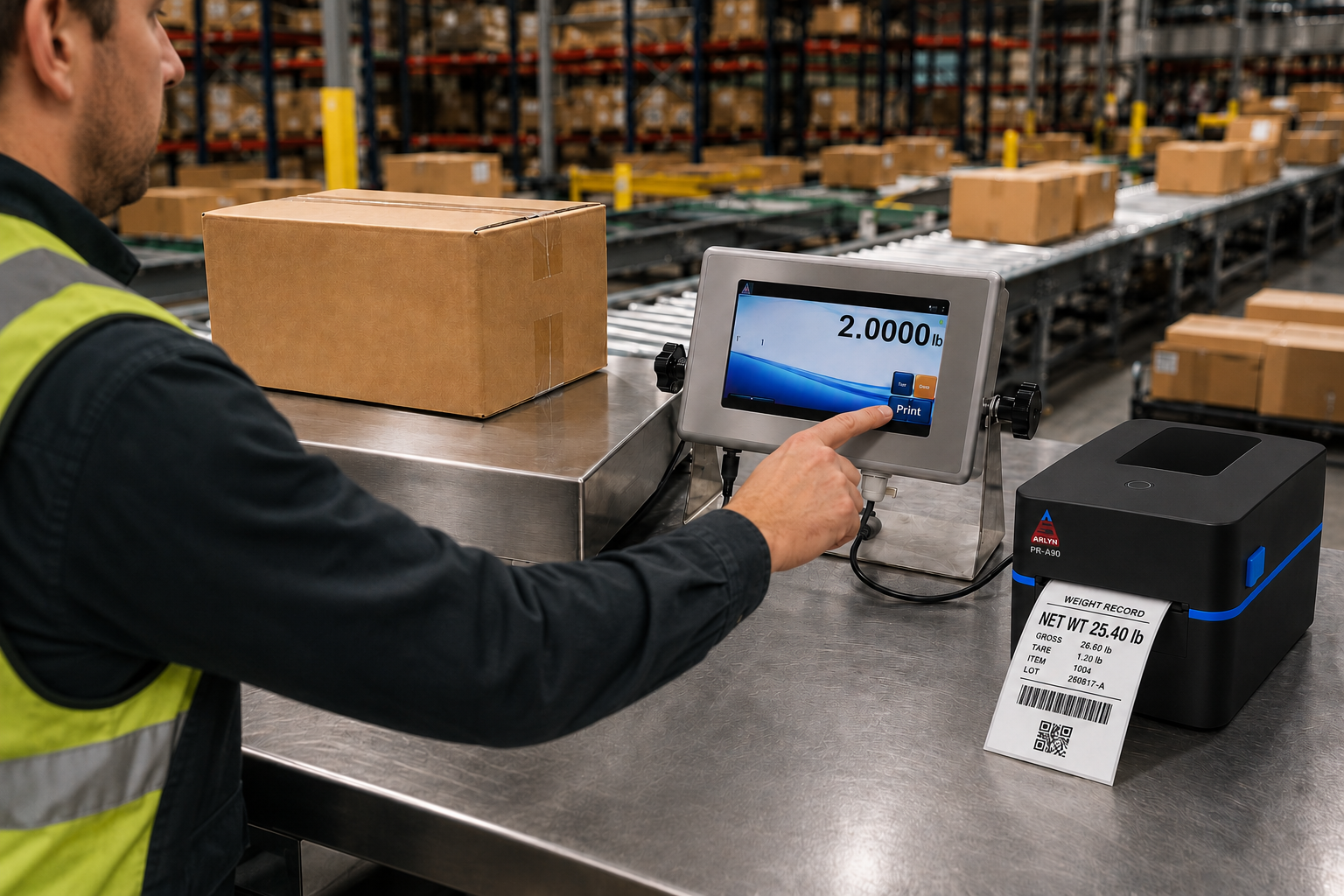
Barcode scanning and printing for industrial scales can connect identification, weighing, and record creation at one workstation. With a compatible Arlyn UpScale configuration, an operator can scan an item or container, retrieve the appropriate stored information, capture the weight, and print a configured label without re-entering the same data at a separate computer.
It allows the weighing station to identify what is being weighed, apply supported stored data such as a tare or sample definition, and create a printed record from the resulting measurement. Barcode and QR-code functions require the correct UpScale options, compatible hardware, and a validated configuration for the intended workflow.
Explore the Arlyn UpScale
Compare Compatible Scale Printers
How Barcode Scanning Works with an Industrial Scale
A barcode does not weigh the item or improve the scale’s accuracy. Its role is identification. The scanned value can tell the UpScale which stored record, tare, sample, product, or process context should be used for the current operation.
- Identify the item or container. The operator scans a supported 1D barcode or 2D code, such as a QR code, using the configured scanner or UpScale camera workflow.
- Retrieve the associated information. The UpScale uses the scanned value to locate the applicable stored definition or supported field mapping.
- Capture the measurement. The scale weighs the item and applies the active tare, sample, or other configured process data.
- Create the record. When printing is included, the operator presses PRINT and the selected print frame sends the approved fields to the configured printer.
The database definitions, field mappings, printer connection, and print frames are prepared during setup. Routine operation should remain focused on the weighing task rather than label design or printer configuration.
Common Barcode Weighing Workflows
| Application | What the scan identifies | Scale action | Possible printed record |
|---|---|---|---|
| Parts counting | Part or sample ID | Retrieve the stored sample definition and calculate quantity | Part number, count, piece weight, and total weight |
| Container or vessel weighing | Container or tare ID | Apply the stored tare and calculate net weight | Container ID, gross, tare, net, and unit |
| Production or batch tracking | Product, work order, lot, or batch | Associate the measurement with configured process fields | Product, lot, operator, date/time, and measured result |
| Receiving, inventory, or shipping | Item, pallet, shipment, or location ID | Capture weight with the active receiving or inventory record | Item or pallet ID, weight, location, destination, and scannable code |
These examples describe common workflow patterns, not a promise that every field is available in every configuration. The required variables, data structure, scanner behavior, and output format should be confirmed before deployment.
Using Barcodes for Stored Tares and Samples
Retrieve a Stored Tare
A tare represents the weight of a container, fixture, or other item that must be removed from the gross measurement. When each recurring container has a stored Tare Definition and a corresponding ID, scanning the container can retrieve the correct tare without requiring the operator to search through the database manually.
The scale can then calculate net weight as gross weight minus the active tare. The operator should confirm that the correct definition is active before accepting or printing the result.
Retrieve a Parts-Counting Sample
A parts-counting sample definition associates a known part with the sample information used to calculate quantity. A scanned part ID can retrieve the appropriate stored Sample Definition, reducing the chance that an operator selects the wrong part from a long list.
Both workflows depend on the required definitions being created, verified, and stored in the UpScale before the related codes are used in production.
Barcode Scanning and Label Printing Are Separate Functions
Scanning and printing often work together, but they solve different parts of the process:
- Scanning brings an identifier or encoded value into the weighing workflow.
- Printing creates a physical record containing the selected measurement and process information.
- A combined workflow can use the scanned identity to establish context and then print a label for the weighed item.
An UpScale configuration may include scanning only, printing only, or both. The appropriate Barcode and QR Code Function, scanner, printer, and connection must be included in the scale configuration. Selecting a printer by itself does not automatically add barcode scanning or barcode/QR printing capability.
How Custom Label Templates Fit into the Workflow
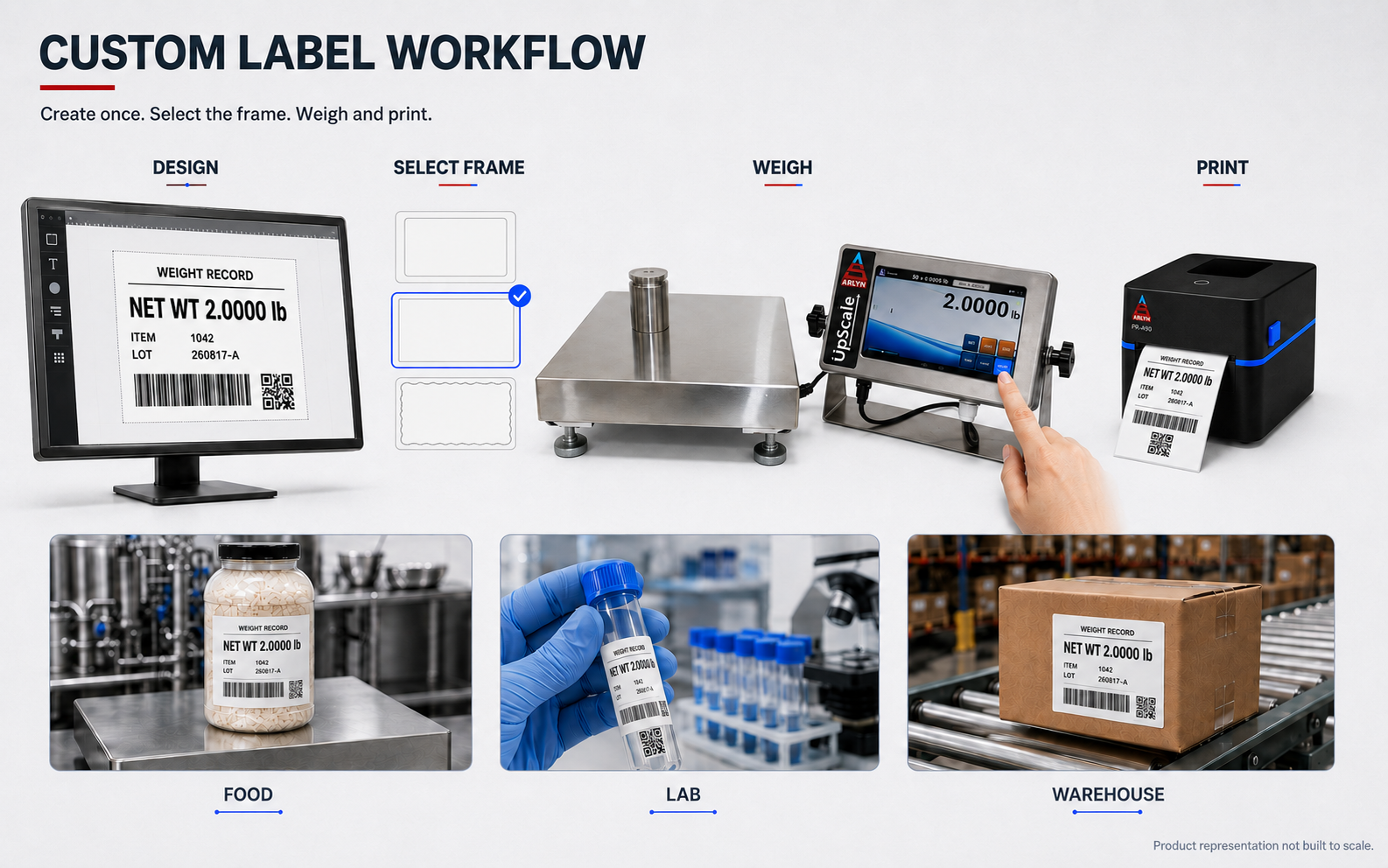
Label layouts are prepared before the scale is placed into routine service. OpenLabel is available for creating the visual layout. Arlyn LabelTag, the planned field-mapping utility, is coming soon. Until it is released and validated, the complete automated field-mapping workflow should be treated as planned rather than currently available.
Once the print frame has been selected, the operator continues to use the standard UpScale weighing screen. The normal sequence is to identify the item when required, capture the weight, confirm the record, and press PRINT. Label design and field mapping remain setup tasks rather than operator tasks.
Choosing a Printer for the Workflow
The industrial scale printer comparison owns current model, connection, media, compatibility, and pricing details. Use the PR-A90 product page when the workflow calls for wider direct thermal labels. Selecting a printer does not by itself add scanning or barcode and QR-code printing. Those functions must be included in the compatible UpScale configuration.
What Must Be Configured Before Operators Begin
- A compatible scale equipped with the Arlyn UpScale touchscreen indicator
- The required scanning, printing, or combined Barcode and QR Code Function
- A supported scanner and/or printer with the approved connection method
- Stored Tare Definitions, Sample Definitions, or other records required by the process
- Verified barcode or QR-code values that match the intended stored records
- A validated print frame containing the required supported fields
- Qualified label or receipt media for the selected printer
- A test procedure covering scanning, weighing, calculations, print output, and exception handling
Configuration should be validated with the actual scale, indicator software, printer, scanner, media, and label format that will be used in production.
A Simple Operator Workflow
- Confirm that the scale is ready and that the correct process or print frame is active.
- Scan the item, part, container, lot, or other identifier when the workflow requires it.
- Verify that the expected tare, sample, or supporting record has been selected.
- Place the item on the platform and allow the weight to stabilize.
- Review the displayed result and any applicable gross, tare, net, count, or custom-field information.
- Press PRINT to produce the configured record.
- Check the first output when beginning a run or changing the label, media, printer, or print frame.
Exact screen controls and scanner prompts may vary by UpScale software version and purchased options. Refer to the current Arlyn UpScale user manual and the configuration instructions supplied with the scale.
Plan the Complete Barcode Weighing Configuration
Start with the process: identify what will be scanned, what the scale must calculate, which fields must appear on the record, and where that record will be used next. Arlyn can then help match the scale, UpScale options, scanner, printer, connection, media, and print frame to the intended operation.
Discuss Your Barcode Weighing Workflow
Compare Scale Printers