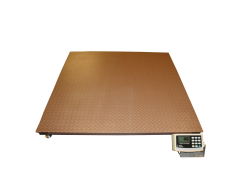
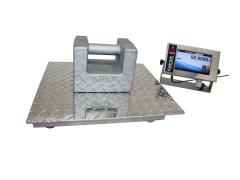
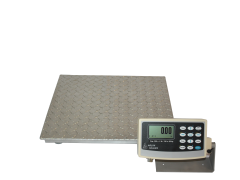
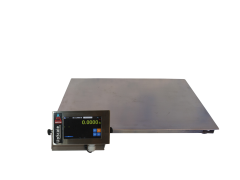
The right industrial platform scale must do more than support the maximum load. Its platform dimensions, capacity, resolution, construction, load-handling arrangement, indicator and data connections must work together in the environment where the scale will be used.
A platform scale that is too small may create unstable loading. One with insufficient capacity can be overloaded. A scale with unsuitable construction may deteriorate in a wet or corrosive environment, while an unnecessarily specialized configuration may increase cost without improving the process.
What Is an Industrial Platform Scale?
An industrial platform scale uses a broad, flat weighing surface to support boxes, containers, carts, ingredients, equipment and other loads that are too large or awkward for a conventional countertop balance.
Platform scales are commonly used in:
- Manufacturing and assembly
- Shipping and receiving
- Warehousing and inventory control
- Airports and transportation
- Commercial laundry operations
- Food and ingredient processing
- Recycling and waste handling
- Agriculture and animal weighing
- Chemical and industrial facilities
They should not be selected solely by appearance or maximum capacity. The scale must fit the load, process and physical installation.
Platform Scale Selection at a Glance
| Selection factor | What to determine | Risk if overlooked |
|---|---|---|
| Capacity | Heaviest product plus every container, cart, pallet or fixture | Overloading, damage or unusable equipment |
| Resolution and accuracy | The smallest weight change and process tolerance that matter | Product giveaway, unreliable decisions or unnecessary expense |
| Platform dimensions | Load contact points, center of gravity and available space | Unstable loads, contact with nearby objects or wasted floor space |
| Construction | Expected impacts, moisture, chemicals and cleaning procedures | Corrosion, sensor damage and shortened service life |
| Loading method | Manual lifting, carts, dollies, pallet handling or fixed installation | Unsafe handling, slow cycles or platform impacts |
| Indicator and data | Functions, mounting, data destination and equipment integration | Manual work, transcription errors or incompatible systems |
| Application fit | Evaluate all factors as one weighing system | Prevents buying a scale that solves only part of the problem |
Step 1: Determine the Complete Weight Range
Start with the lightest and heaviest loads the scale must measure. Maximum capacity must include everything supported by the platform, not only the product.
Include:
- The material or product
- Boxes, bins, totes or drums
- Carts, dollies or pallets
- Fixtures, braces or supports
- Any equipment resting on the scale during operation
For example, if a cart weighs 150 pounds when empty and carries 300 pounds of material, the scale must support at least the combined 450-pound load.
Allow reasonable capacity for ordinary process variation, but do not select a dramatically higher capacity without a defined need. Higher capacity can affect available resolution, physical construction and cost.
Step 2: Define the Required Resolution and Accuracy
Capacity answers how much the scale can weigh. Resolution and accuracy help determine whether it can make the measurement your process needs.
- Resolution is the smallest increment displayed by the indicator.
- Readability describes the total number of displayed increments across capacity.
- Accuracy describes how closely the measured result agrees with an accepted value under specified conditions.
The smallest displayed increment should be fine enough to support the relevant decision. A shipping operation, formulation process and parts-counting application may require very different performance.
Do not specify resolution solely by choosing the greatest number of decimal places. Ask:
- What is the smallest weight change that affects the process?
- What product or quality tolerance must be maintained?
- What is the cost of overfilling, underfilling or an incorrect result?
- Will vibration, air movement or temperature interfere with sensitive readings?
- Is the required performance needed across the full capacity?
A standard strain-gauge platform scale is appropriate for many industrial applications. When substantially finer measurement performance is required, compare an Ultra Precision platform scale with the required capacity and tolerance.
Step 3: Measure the Load, Not Just the Available Floor Space
Platform dimensions should be selected from the load’s physical support requirements.
Measure:
- Overall length and width
- Location of feet, wheels or contact points
- Center of gravity
- Potential overhang
- Clearance needed for handling equipment
- Available installation area
A load may extend beyond the edge of a platform if it remains stable, does not contact another surface and transfers its entire force through the scale. However, all feet or support points generally need to rest securely on the weighing surface unless the system was designed differently.
An oversized platform may consume floor space and complicate loading. An undersized platform may encourage unstable placement or allow the load to touch walls, ramps or nearby equipment.
When Is a Custom Platform Size Necessary?
A custom platform may be appropriate when:
- The load’s contact points do not fit a standard platform
- A tank, fixture or machine must be mounted directly on the scale
- Available floor space has unusual dimensional constraints
- The weighing platform must align with existing equipment
- Several containers must be weighed together
- The center of gravity requires a different support arrangement
Custom sizing should be based on a drawing or measured dimensions, including clearances and load-placement tolerances.
A custom platform is not necessary simply because an object overhangs the surface. The manufacturer should review how the load is supported before additional fabrication is specified.
Step 4: Choose Aluminum or Stainless Steel Construction
The appropriate platform material depends on the environment, handling method and cleaning requirements.
| Consideration | Aluminum construction | Stainless steel construction |
|---|---|---|
| Typical environment | General industrial and comparatively dry applications | Wet, corrosive or frequently cleaned applications |
| Portability | Lower weight can make relocation easier | Generally heavier and better suited to fixed installations |
| Corrosion resistance | Application-dependent; chemical compatibility must be reviewed | Often preferred for moisture and many corrosive environments |
| Budget | Often the economical choice when additional protection is unnecessary | Additional investment may prevent corrosion and early replacement |
| Selection rule | Choose the least costly construction that can reliably survive the actual environment and cleaning process. | |
Stainless steel is not universally resistant to every chemical. If the scale will encounter corrosive material, provide the chemical name, concentration, temperature and exposure pattern. Specialized corrosion-resistant scale construction or coatings may be required.
Step 5: Evaluate Load-Cell Construction and Placement
The platform is the visible part of the scale, but the load cells produce the measurement signal.
Arlyn platform scales use four stainless steel load cells positioned beneath the platform. A four-corner arrangement supports a broad weighing surface and helps the system measure loads placed at different positions when the scale is installed and calibrated correctly.
When comparing platform scales, ask:
- How many load cells support the platform?
- What material are the load cells made from?
- How are they protected from overloads and impacts?
- Are cables and connections protected from the environment?
- How is corner performance tested?
- Can damaged components be serviced?
Do not judge durability solely by the thickness or appearance of the top plate. The frame, load cells, feet, cables and stops are all part of the mechanical system.
Step 6: Plan How Loads Will Reach the Platform
A suitable platform scale must fit the material-handling process.
Manual loading
For boxes, bags and smaller containers, consider platform height, lifting distance and the frequency of each weighing cycle.
Carts and dollies
A low-profile platform and compatible ramp can reduce lifting. The ramp must not contact or bind against the active weighing structure.
Pallet jacks and forklifts
Determine whether the intended equipment can approach, place and remove the load without striking the platform or exceeding the scale’s impact tolerance. Large palletized loads may be better suited to a dedicated floor scale.
Fixed containers and machinery
Tanks, fixtures and equipment may require custom mounting, plumbing flexibility, cable routing or restraints that do not bypass the weighing system.
Step 7: Check the Operating Environment
Environmental conditions can affect both measurement performance and equipment life.
Document:
- Indoor or outdoor installation
- Water, condensation and washdown exposure
- Acids, bases, salts, solvents or cleaning chemicals
- Temperature range
- Vibration from adjacent equipment
- Air movement around sensitive measurements
- Dust and debris accumulation
- Sanitation requirements
- Potentially flammable gases, vapors, dusts or fibers
Ordinary industrial equipment must not be used in a classified hazardous location simply because its capacity and platform fit the load. The applicable class, division, group or zone must be established, and an approved intrinsically safe scale configuration must be selected where required.
Step 8: Choose the Appropriate Digital Indicator
The indicator is the operator’s interface with the platform scale. Its required functions may include:
- Zero and tare
- Gross and net weight
- Unit conversion
- Stored tare or item information
- Parts counting
- Set-point control
- Printing
- Data logging
- Computer or network communication
A standard MKE-5 indicator may be appropriate for straightforward weighing and control functions. The Arlyn UpScale touchscreen indicator should be considered when a process benefits from a color touchscreen, configurable workflows, advanced connectivity, barcode functions or industrial communication protocols.
More features do not automatically make an indicator the better choice. Select the interface that makes the required workflow simpler and more reliable.
Step 9: Identify Where the Weight Data Must Go
If an employee must copy every reading manually, the scale may become a bottleneck even when its measurement is correct.
Depending on the selected configuration, available communication paths may include:
- RS-232
- RS-422 or RS-485
- USB communication
- Ethernet TCP/IP
- Wireless TCP/IP
- Analog output
- Industrial protocols with compatible equipment
- Printing and barcode functions
- USB data logging
- Cloud or spreadsheet integration
Before selecting an output, identify the receiving computer, PLC, printer, network, database or software application. Confirm the electrical interface, protocol and required data format.
Review available scale options and communication methods for current integration pathways.
Step 10: Decide Whether Weight Must Control Other Equipment
Some platform-scale applications require the measured weight to trigger an action.
Set-point and control functions may be used to:
- Start or stop a pump
- Open or close a valve
- Operate a feeder or conveyor
- Signal acceptable, underweight or overweight conditions
- Control filling or dispensing
- Support batching and mixing
Define the target weights, output type, controlled equipment, sequence and fail-safe behavior before ordering. A scale output alone does not constitute a complete automation design.
Standard Platform Scale or Custom Weighing System?
Customization can occur at several levels.
| Solution level | Best fit | Typical requirements |
|---|---|---|
| Standard platform scale | An existing platform, capacity and indicator meet the application. | Routine weighing in an ordinary industrial environment |
| Configured standard scale | The mechanical scale fits, but additional functions are required. | Indicator, connectivity, printer, battery, set points or enclosure |
| Modified platform | The load requires different dimensions or mechanical features. | Custom size, mounting, cable, frame or handling arrangement |
| Custom weighing system | The scale must become part of a machine, process or multi-device workflow. | Engineering, sensors, controls, software, fabrication and acceptance testing |
Use a standard configuration when it satisfies the application. Choose customization when it resolves a defined mechanical, environmental, measurement or integration requirement.
Common Platform Scale Selection Mistakes
Avoid these frequent problems:
- Selecting capacity without including the container or cart
- Choosing a platform from overall load dimensions without checking its contact points
- Assuming more decimal places automatically mean appropriate accuracy
- Using ordinary construction around corrosive chemicals
- Failing to allow approach space for carts or handling equipment
- Allowing a ramp, wall or pipe to contact the active weighing structure
- Purchasing every communication option without identifying the receiving system
- Using nonapproved electrical equipment in a classified location
- Ignoring shock loading from dropped or forcefully placed loads
- Ordering custom fabrication before confirming that a standard platform is unsuitable
Platform Scale Quote Checklist
Provide the following information when requesting a recommendation or quote:
- Minimum and maximum load
- Container, cart, pallet or fixture tare weight
- Required displayed increment and tolerance
- Load dimensions and contact-point drawing
- Available installation space
- Loading and unloading method
- Indoor, outdoor, wet or corrosive conditions
- Hazardous-location classification, if applicable
- Required indicator functions
- Computer, printer, PLC or network connection
- Set-point or automation sequence
- Power requirements
- Quantity and delivery location
Photographs and drawings can help identify obstructions, handling limitations and custom mechanical requirements.
Find the Platform Scale That Fits Your Application
Arlyn Scales offers aluminum and stainless steel platform scales, multiple capacities and dimensions, Ultra Precision configurations, intrinsically safe systems and custom weighing solutions.
The correct system may be a standard platform scale with no additional options. It may instead require a different platform, advanced indicator, data connection, environmental protection or automation. Defining the application first makes that distinction clear.
Frequently Asked Questions
How do I choose the correct platform scale capacity?
Add the heaviest product to the tare weight of every container, pallet, cart, fixture or other object supported by the scale. Include reasonable operating variation without selecting excessive unused capacity.
Does a larger platform make a scale less accurate?
Not inherently. Measurement performance depends on the complete design, load-cell arrangement, calibration, installation and operating conditions. A custom or enlarged platform should be reviewed by the manufacturer, but platform size alone does not determine accuracy.
Can an object hang over the edge of a platform scale?
Potentially, if the object remains stable, does not contact the floor or surrounding equipment and transfers its full weight through the scale. Its feet or support points must be positioned appropriately for the platform and scale design.
Should I choose an aluminum or stainless steel platform scale?
Aluminum is often economical and easier to move in general industrial environments. Stainless steel should be evaluated for moisture, cleaning or corrosive exposure. Chemical compatibility must be reviewed for the specific substance and conditions.
When do I need an Ultra Precision platform scale?
Consider Ultra Precision technology when a standard industrial platform scale cannot provide the resolution or accuracy required at the needed capacity. The decision should be based on process tolerance and operating conditions.
Can a platform scale connect to a computer or PLC?
Yes, depending on its indicator and selected options. Potential interfaces include serial communication, USB, Ethernet, Wi-Fi, analog output and compatible industrial protocols. Confirm the receiving system and protocol before ordering.
Can Arlyn make a custom platform size?
Arlyn can review custom platform dimensions and mechanical requirements. Provide the load size, contact points, center of gravity, capacity, installation space and handling method so the complete structure can be evaluated.
When should I choose a floor scale instead of a platform scale?
A floor scale may be more appropriate for large pallets, very heavy loads, forklift handling or applications requiring larger platforms and capacities. The dividing line depends on the load and workflow rather than terminology alone.