Cylinder Scales For Cylinders, Pails and Tanks
Starting at $699

.
Gas cylinder scales and tank scales measure the weight of cylinders, pails, Dewars, tanks and chemical containers while they are being stored or used. By continuously measuring weight, an operator or control system can estimate the quantity remaining, monitor consumption and receive a warning before a process runs out of material.
Arlyn Scales offers compact Series 620G cylinder scales, high-capacity A-TON chlorine ton scales and intrinsically safe ArlynGuard configurations for classified hazardous locations. Construction, capacity, readability, environmental protection and communication options can be selected according to the container and operating environment.
Which cylinder scale do you need for a chemical or gas application?
Select the scale according to four requirements: the total filled-container weight, the container footprint, the chemical exposure and the hazardous-area classification. A standard 620G may suit an ordinary industrial location, an all-stainless or specially coated system may be needed around corrosive chemicals, and an approved ArlynGuard configuration is required when the scale will operate in a classified hazardous location.
A pressure gauge does not always provide a useful indication of the quantity remaining in a cylinder containing liquefied gas. While liquid remains and continues to vaporize, cylinder pressure can remain relatively stable for a given temperature. A substantial pressure decrease may occur only after the liquid phase is depleted.
A cylinder scale measures the mass of the entire container and its contents. After accounting for the tare weight of the empty cylinder, the system can estimate the remaining product:
Remaining contents = measured gross weight − cylinder tare weight
Because weight changes as material leaves the cylinder, the measurement can also support consumption tracking, replenishment planning, low-level alerts and weight-based flow calculations.
A scale can identify an unexpected loss of weight, but it is not a replacement for an appropriate gas detector, pressure-protection device, ventilation system or facility safety procedure.
| Scale Family | Capacity and Readability | Construction and Format | Best Suited For |
|---|---|---|---|
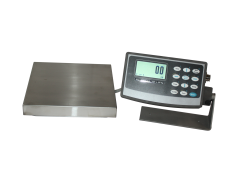
| Series 620G Cylinder Scale | 60 or 100 lb × 0.02 lb 300 or 400 lb × 0.1 lb |
9.25-inch-square, 1 3/8-inch-high platform; stainless platform and load cell; optional all-stainless construction | Gas cylinders, pails, dewars, gas cabinets, laboratory supplies and chemical feed containers in ordinary industrial locations |
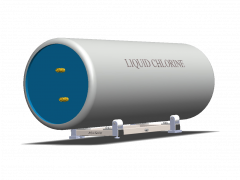
| A-TON Chlorine Ton Scale | 5,000 lb × 1 lb per platform | 37-inch × 20-inch stainless cradle with four stainless-steel load cells; single or dual configuration | One-ton chlorine, sulfur dioxide and similar horizontal chemical containers in nonclassified locations |
| ArlynGuard C | 60 or 100 lb × 0.02 lb 300 or 400 lb × 0.1 lb |
Compact cylinder platform using FM-approved intrinsically safe components; configuration dependent | Compatible cylinders in classified locations requiring an approved intrinsically safe weighing system |
| ArlynGuard T | 5,000 lb × 1 lb per platform | Full stainless cradle with four load cells and FM-approved intrinsically safe components; single or dual configuration | Chlorine ton containers and similar applications in compatible classified hazardous locations |
| Corrosion-Resistant Scale | Selected according to the platform, container and application | Stainless construction with a three-part polyamine epoxy coating on designated models | Applications requiring enhanced resistance to specific corrosive chemicals or repeated chemical exposure |
| Best selection method | Use total filled weight, not contents weight alone | Match every wetted or exposed component to the operating environment | Confirm chemical compatibility and hazardous-area requirements before ordering |
The required scale capacity must exceed the combined weight of the full container and its contents. Selecting capacity according to the chemical contents alone can result in an undersized scale.
For example, the calculation should include:
Readability is the smallest weight increment shown by the scale. A 300 lb × 0.1 lb configuration has a maximum capacity of 300 lb and displays weight in 0.1 lb increments. Readability is not the same as accuracy. The standard 620G specification lists accuracy and repeatability separately from its displayed increment.
The Series 620G specification also lists a maximum safe load of 150% of capacity. That protection is not permission to operate above the rated capacity. Routine loads should remain within the selected capacity, and cylinders should be positioned without severe impact or side loading.
Gas cylinders are tall, heavy and potentially unstable while being moved. A high platform requires the operator to lift or tilt the cylinder farther, increasing handling difficulty and the possibility of impact loading.
The Series 620G platform is approximately 1 3/8 inches high. Its compact footprint can fit beneath cylinders, pails and tanks in areas where floor space or gas-cabinet clearance is limited.
The low profile can simplify loading, but the scale does not replace an appropriate cylinder restraint, cart, lifting device or facility handling procedure. Cylinders should be secured according to the requirements of the container, gas and installation.
These terms describe different properties and should not be treated as interchangeable.
A standard 620G configuration may be appropriate when the area is not classified as hazardous and the expected chemical exposure is compatible with the platform, frame, indicator, cable and connectors.
Every standard 620G includes a stainless-steel platform and stainless-steel load cell. All-stainless construction extends the material choice to additional structural components. This can improve corrosion resistance, but it does not guarantee compatibility with every chemical or concentration.
Applications involving aggressive chemicals, frequent spills or sustained vapor exposure may require a designated corrosion-resistant scale, additional coating or a custom material evaluation. Chemical compatibility depends on the specific substance, concentration, temperature, exposure time and cleaning procedure.
A standard stainless-steel scale is not automatically intrinsically safe. When flammable gas, vapor or combustible dust may create a classified hazardous location, the complete weighing system must use a configuration approved for that classification.
ArlynGuard C and ArlynGuard T systems use FM-approved components for specified hazardous-location classifications. The model, power configuration, indicator location, barrier arrangement, wiring and accessories must match the approved system documentation and the actual area classification.
Important hazardous-area distinction
Corrosion resistance protects equipment from chemical attack. Intrinsic safety limits electrical and thermal energy that could cause ignition. One property does not provide the other. Have the area classification and complete installation reviewed by qualified safety personnel before selecting a scale.
Semiconductor fabrication uses process gases for deposition, etching, oxidation, doping, cleaning and inerting. Continuous cylinder weight can help operators monitor consumption and schedule cylinder changes before the gas supply interrupts production.
Cylinder scales can track material supplied to reactors, mixers, dosing systems and production lines. Analog, digital or network outputs can transmit weight to a control or data-acquisition system.
Chlorine and sulfur dioxide containers may be monitored by weight to support chemical-feed operations and replacement planning. Ton containers require a scale and cradle designed for their size, orientation and total filled weight.
Compact cylinder scales can monitor specialty gases, cryogenic containers, pails and chemical supplies. The required readability should be selected according to the change in contents the process must detect.
Carbon dioxide, nitrogen and other gases may be monitored in bottling, modified-atmosphere packaging, freezing and processing applications. Construction and sanitation requirements must be reviewed separately from basic weighing specifications.
Weight monitoring can help track argon, carbon dioxide and other welding gases where uninterrupted supply is important to production.
A local display is sufficient for some applications. Other operations need the scale to alert personnel, communicate with a PLC, record consumption or control compatible equipment.
| Operational Requirement | Relevant Option | Typical Function |
|---|---|---|
| View weight beside the cylinder | MKE-5 digital indicator | Displays gross, tare and net weight and supports standard local weighing functions |
| Send a continuous signal to existing controls | 4–20 mA, 0–5 VDC or 1–5 VDC | Provides a scalable analog weight signal for compatible PLC, recorder or control equipment |
| Transfer digital weight data | RS-232, RS-422, RS-485, USB or Ethernet | Connects the scale to compatible computers, controllers and data systems |
| Generate a low-level alarm | Setpoints, relays, buzzer or light tower | Activates compatible equipment or alerts personnel when a programmed weight condition is reached |
| Track usage and flow by weight | Data logging or UpScale flow-rate function | Records changes in weight over time for consumption analysis or process monitoring |
| Connect to industrial automation | Modbus, EtherNet/IP or PROFINET with a compatible UpScale configuration | Exchanges weight and process data with compatible PLC, SCADA or automation systems |
| Monitor cylinders remotely | AxChange, Wi-Fi, Google Sheets or scheduled reports with UpScale | Provides configured remote visibility, historical records or alerts |
| Best integration practice | Identify the receiving device and protocol before ordering | Confirm data format, electrical interface, update requirements and hazardous-area boundaries |
Available options depend on the selected model, indicator and system configuration. Advanced electronics used with an intrinsically safe scale may need to remain in a safe area or connect through an approved barrier. Do not place standard communication hardware inside a classified location unless it is included in an approved installation.
Provide the chemical name, concentration, container dimensions, total filled weight, operating temperature, expected exposure and hazardous-area classification. Arlyn can help identify the appropriate construction, capacity, indicator and outputs.
Flexible hoses and piping should be installed so they do not support part of the cylinder weight or introduce changing side forces. A stable, level mounting surface and proper calibration are also essential for dependable measurements.
Arlyn Scales can help match the platform, capacity, construction, hazardous-area configuration and communication options to your cylinder, chemical and process.
Configure a 620G Cylinder Scale
Discuss a Custom Application
Call 800-645-4301 to speak with Arlyn Scales.
Liquid gases are used across a broad range of industries. Liquid nitrogen is used in cryogenics. Argon is used in welding. The semiconductor industry uses many different liquid gases in the production of silicon wafers. These include silicon tetrafluoride, silicon tetrachloride, silane, disilane, and dichlorosilane, to name just a few. Weighing Liquified Gases In Cylinder … Continued
The semiconductor industry is often thought of as being at the leading edge of technology. That is certainly the case in many of the operations necessary for producing today’s microprocessor and memory devices. But in fact, most of the processes required for fabricating integrated circuits are much more standard levels of complexity. For example, a … Continued
Electronic cylinder scales provide a useful method to measure the weight of liquefied gasses. These are gasses that under pressure become a liquid and are pumped into a cylinder. For the purposes of liquefied gases, the user wants to ensure reliable and accurate measurement. Accuracy helps maintain high levels of product purity and consistency. What … Continued
Cylinder scales are designed to weigh metal drums, tanks and pails that contain liquids and other materials of various types. ArlynScales carries high quality cylinder scales with stainless steel platforms that are durable and can do much more than simply weigh the containers for you. Cylinder scales are designed to weigh metal drums, tanks and … Continued
The Importance of Flow Rate and Gas Cylinder Scales Options Weight measurement is one of the most common industrial processes and is performed by a wide variety of industrial scales. Another common industrial measurement is flow rate. Flow rate is important because it is used for fluids and liquified gasses. Many chemical processes need to … Continued
The semiconductor industry uses a wide range of specialty gases during the processing of silicon wafers. Standard atmospheric gases include helium and nitrogen, along with argon, oxygen and hydrogen. Other gases may include dichlorosilane, disilane, silane, silicon tetrachloride and silicon tetrafluoride. There are additional gases used during the doping and etching states including boron trifluoride, … Continued
The best scale to measure liquefied gases is a digital cylinder scale. A digital cylinder scale determines the weight of the liquid in cylinders, not the volume of gas in the cylinders. Liquefied gases require special scales, because of the weight and size of the containers. The scales operate when a gas cylinder is placed … Continued
The best scale to measure liquefied gases is a digital cylinder scale. A digital cylinder scale determines the weight of the liquid in cylinders, not the volume of gas in the cylinders. Liquefied gases require special scales, because of the weight and size of the containers. The scales operate when a gas cylinder is placed … Continued
Liquefied gases play a crucial role in various industrial processes. Cryogenic applications often require liquefied nitrogen and other gases. Liquefied carbon dioxide finds application in the production of chemicals, manufacturing fertilizers, plastics, rubber, fire extinguisher systems, carbonating soft drinks, and numerous other uses. In the semiconductor industry, different liquefied gases are utilized for wafer … Continued
A number of specialty gasses play a prominent role in semiconductor fabrication. These gasses may be used to clean the silicon substrates, and to etch and process the silicon wafers. It is critical during the fabrication process that each of the gasses be available when needed. An entire batch of wafers, which can represent thousands … Continued
Copyright © 2007-2026 Circuits & Systems Inc. Arlyn Scales. All Rights Reserved.