A low-cost, high-accuracy industrial scale is not necessarily the scale with the lowest purchase price. It is the scale that provides the required capacity, readability, accuracy, and durability without forcing the buyer to pay for unnecessary performance or features.
A conventional industrial scale may be economical, but it may not display weight changes small enough for precision counting, formulation, filling, or inventory monitoring. A laboratory balance may provide finer measurements, but it may also have a small weighing pan, limited capacity, and a mechanism that is poorly suited to routine industrial handling.
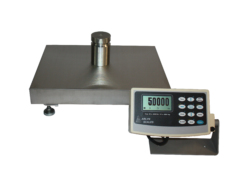
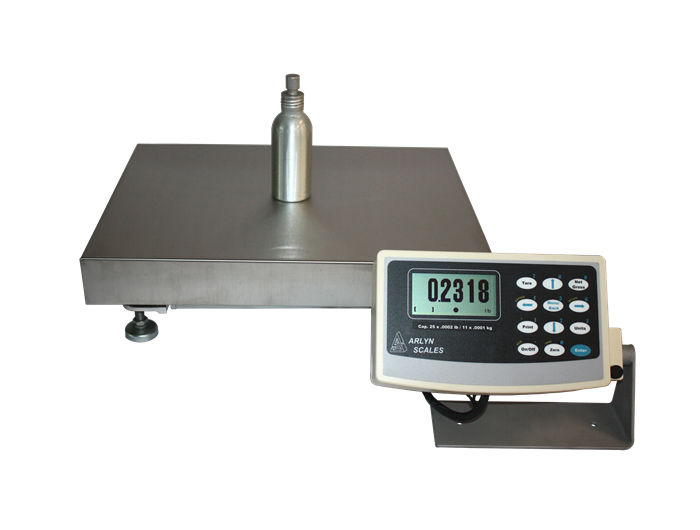
Arlyn Ultra Precision Scales use patented Surface Acoustic Wave, or SAW, technology to bridge this gap. They provide substantially finer readability than typical industrial strain-gage scales while supporting capacities from 10 to 1,000 pounds.
What is the best low-cost, high-accuracy scale?
The best value comes from choosing the lowest practical capacity that safely supports the complete load while providing the readability your process actually needs. Arlyn SAW Scales provide up to 10 to 20 times finer readability than representative general-purpose industrial scales. Premium SAW models provide up to 40 times finer readability.
What Does Low-Cost, High-Accuracy Really Mean?
The word low-cost should describe the total value of the weighing system, not simply its initial price. A scale becomes expensive when it cannot detect the required weight change, fails in the operating environment, or creates additional waste and labor.
Three measurements should be considered before comparing scale prices:
Readability is the smallest weight increment shown on the display. A 100 lb scale with 0.001 lb readability changes its displayed value in increments of one-thousandth of a pound.
Accuracy describes how closely the displayed measurement agrees with the actual weight. More decimal places do not automatically make a scale more accurate.
Total cost includes the scale, required options, installation, maintenance, material waste, measurement errors, labor, and the consequences of choosing insufficient performance.
The most economical scale is the one that reliably meets the measurement requirement with the least unnecessary complexity.
Why Surface Acoustic Wave Technology Is Cost-Effective
Most general-purpose industrial scales use strain-gage load cells. These sensors measure small changes in electrical resistance as a metal spring element bends under load.
Arlyn SAW transducers use a different method. They measure changes in acoustic frequency caused by extremely small mechanical displacement. Because frequency can be measured precisely, the system can detect smaller changes in load without requiring the scale structure to deform as much as a conventional strain-gage design.
This provides several practical advantages:
- Finer readability: Standard SAW models provide up to approximately 1:100,000 displayed resolution.
- Premium resolution: Premium models provide up to approximately 1:200,000 displayed resolution.
- Industrial capacity: Standard product configurations range from 10 to 1,000 lb.
- Strong overload protection: Current Ultra Precision models provide up to 250% safe overload protection.
- Flexible configuration: Buyers can select the platform, indicator, and outputs needed for the application.
This combination allows SAW scales to provide substantially finer measurement performance than a general industrial scale without requiring the user to move the process onto a small laboratory balance.
Arlyn Ultra Precision Scale Options
Arlyn offers three primary Ultra Precision product families. The correct series depends on the maximum load, smallest required increment, and platform dimensions.
| Product Family | Capacity Range | Finest Readability | Displayed Resolution | Standard Platform | Best Fit |
|---|---|---|---|---|---|
Premium Ultra Precision |
10–100 lb | 0.00005 lb |
Up to 1:200,000 | 9 × 8 in | The finest standard Arlyn readability in a compact bench-scale format |
Standard Ultra Precision |
10–200 lb | 0.0001 lb |
Approximately 1:100,000 | 12 × 12 in or 12 × 16 in | High-resolution industrial weighing with configurable indicators and outputs |
Large Ultra Precision |
200–1,000 lb | 0.002 lb |
Approximately 1:100,000 or better, depending on model | 20 × 23 in or 31.5 × 31.5 in | Larger vessels, containers, assemblies, and heavier products requiring fine readability |
Note: Readability, platform dimensions, and displayed resolution vary by model. Custom sizes and capacities may also be available. Confirm the final specifications before ordering.
How Does SAW Compare with Other Scale Technologies?
Not every weighing application requires SAW technology. A general-purpose strain-gage scale may provide the best value for basic weighing, while an electromagnetic force restoration balance may be appropriate for extremely fine, low-capacity laboratory measurements.
| Comparison Point | Strain-Gage Scale General industrial weighing |
Arlyn SAW Scale High-resolution industrial weighing |
MFR / EMFR Balance Precision laboratory weighing |
|---|---|---|---|
| Measurement method | Measures resistance changes as a metal spring element bends. | Measures acoustic-frequency changes caused by minute displacement. | Measures the current required to electromagnetically restore a balance mechanism. |
| Representative resolution | Often around 1:5,000 for general-purpose industrial models | Up to approximately 1:200,000, depending on the product series | Can provide substantially finer resolution in analytical and precision applications |
| Capacity and platform | Available in nearly every industrial capacity and platform size | Arlyn configurations range from compact 10 lb scales to 1,000 lb platforms | Commonly used in smaller precision balances and specialized weighing modules |
| Industrial durability | Depends on the platform, load cell, and construction | Designed for industrial platforms with up to 250% safe overload protection | Depends on the balance mechanism and protective enclosure |
| Value proposition | Lowest practical cost when ordinary industrial readability is sufficient | Fine readability without giving up industrial capacity and platform size | Very fine precision when capacity, pan size, and installation requirements are acceptable |
| Best suited for | Basic shipping, receiving, production, and inventory weighing | Precision weighing of heavier products, containers, and industrial batches | Analytical, laboratory, and specialized high-precision measurements |
When Does Higher Resolution Save Money?
A higher-resolution scale provides value when better measurement reduces waste, errors, or manual work. The benefit should be connected to a specific process rather than to resolution alone.
Precision Parts Counting
A counting scale calculates quantity from the total weight and the average weight of one part. When the parts are lightweight, finer scale readability can improve the system’s ability to distinguish one item from the next.
Formulation and Batching
A batch may include a heavy vessel and large base ingredients together with a very small quantity of pigment, catalyst, additive, or active material. A higher-capacity SAW scale can support the entire batch while still detecting the smaller addition.
Filling and Dispensing
Better readability gives a filling process more information as it approaches the target. This can help reduce overfilling, underfilling, and material giveaway when the scale is paired with suitable controls.
Inventory and Consumption Monitoring
A high-resolution scale beneath a tank, cylinder, drum, or material container can detect small changes in the remaining contents. This can improve usage tracking and replenishment planning.
A standard industrial scale remains the more economical choice when its readability is already sufficient. Purchasing more resolution than the process can use does not create additional value.
How to Choose the Correct Ultra Precision Scale
Start with the measurement requirement rather than selecting the model with the highest capacity or the greatest number of decimal places.
Before choosing a scale, determine:
- Maximum gross load: Include the product, container, fixture, tank, or support structure.
- Smallest meaningful weight change: Identify the minimum addition, loss, or difference the scale must display.
- Required platform dimensions: The complete load must fit safely without touching surrounding structures.
- Required measurement tolerance: Readability and accuracy are not the same specification.
- Operating environment: Consider temperature changes, vibration, drafts, moisture, chemicals, and loading conditions.
- Essential outputs: Determine whether the scale must connect to a computer, printer, PLC, network, or control device.
Choosing the lowest capacity that safely supports the complete load generally provides the best readability and avoids paying for unused weighing range.
Need help matching capacity and readability?
Send Arlyn Scales your maximum load, smallest required weight change, platform dimensions, and operating conditions. The team can determine whether your application needs a Premium, Standard, Large, or custom Ultra Precision configuration.
Call 800-645-4301 to discuss your weighing application.
Frequently Asked Questions About Low-Cost, High-Accuracy Scales
What is a low-cost, high-accuracy scale?
What makes Arlyn Ultra Precision Scales cost-effective?
What is a Surface Acoustic Wave scale?
How accurate are Arlyn Ultra Precision Scales?
What is the difference between accuracy and readability?
What is the difference between Standard and Premium Ultra Precision Scales?
Can a high-accuracy scale also have a high capacity?
When is a standard strain-gage scale the better choice?
Can an Ultra Precision Scale connect to a PLC or computer?
Can Arlyn build a custom high-accuracy scale?
What information should I provide when requesting a scale recommendation?
“`