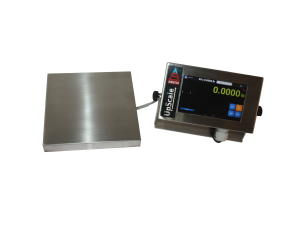
n business for more than 35 years, the scale experts at Arlyn Scales have worked very hard to ensure the scales that we produce are rugged, accurate, and affordable. Headquartered right here in the U.S., Arlyn Scales can listen to our customers and make quick adjustments to ensure our products continue to meet evolving industrial weighing needs.
At Arlyn Scales, we do all we can to ensure our scales are accurate in a variety of industrial environments. But even the most modern digital scales can give inaccurate readings under certain conditions.
Because we’re often asked about the factors that affect weighing machine accuracy, we thought it would be a good idea to expand upon some of the top factors that can greatly affect the accuracy of any scale.
How Can a Weighing Scale Be Wrong?
Many people ask, “Can scales be inaccurate?” or “Why is my digital scale not accurate?” The short answer is yes. Several factors can lead to inaccuracies in weight measurements, even in high-quality scales. Here are some common reasons:
- Improper Calibration: If a scale has not been calibrated correctly, it can provide inaccurate readings. Even relatively good scales can give faulty readings if they are not maintained properly.
- Environmental Factors: Conditions such as extreme temperatures and humidity—and, in high-precision applications, changes in air pressure can significantly affect a scale’s performance. For example, moisture can build up on electronic components, causing interference and incorrect readings.
- Loading Issues: If the scale sits on an uneven or unstable surface, or if the load is not positioned correctly, it may result in a false reading. Always ensure the scale sits on a stable, level surface and the load is positioned correctly to support a reliable measurement.
- Type of Scale: Different types of scales can perform differently. For instance, mechanical scales may be more prone to wear and tear compared to modern digital scales, although performance depends on the scale’s design, condition, and application.
- Mechanical Failures: Both digital and analog scales can experience mechanical failures over time, affecting their ability to provide accurate readings. Regular inspection and maintenance help preserve the performance of all types of scales.
By being aware of these factors, you can better understand how to maintain your scale and ensure accurate readings moving forward.
Factors That Affect the Accuracy of an Industrial Digital Scale
Environmental Factors
There are many environmental factors that can affect the accuracy of your digital scale, including:
- Shock loading – Dropping materials onto a scale can create a momentary force that exceeds its rated capacity can damage the load cell and other components.
- Wind loading – Scales of all kinds can be affected by air movement. The most sensitive indoor scales can even be affected by small amounts of air movement generated by air ducts, or air conditioning units.
- Vibration – Sensitive load cells can misinterpret vibrations from equipment that is close by and in turn provide incorrect weight readings.
- Unclean scales – Scales that are not regularly cleaned can accumulate dirt or debris on the platform and around scale components, adding unwanted weight or creating mechanical interference. Also, the weight on the scale must be completely supported by the load cell(s), which may not occur if significant debris builds up underneath the scale.
- Differences in air pressure – In high-precision applications, a scale’s indicated weight may change when air pressure differs between the calibration and operating environments.
Accuracy of the Load Cell
The load cell is the primary sensing component of any digital weighing system, and a malfunctioning load cell can produce inaccurate weight readings.
There are several parameters that you should be familiar with when looking to understand how load cells function.
- Temperature – Sometimes a scale’s load cell will be exposed to large temperature variations, which can lead to inaccurate readings.
- Nonlinearity – The maximum deviation of a load cell’s calibration curve from a straight reference line.
- Non-repeatability – Variation observed when the same load is measured repeatedly under the same conditions.
- Hysteresis – The difference in scale output at the same load when approaching it from increasing and decreasing directions.
- Creep – The change in the measured weight under a constant load over time.
- Response time – The time that it takes for a load cell to settle and produce a stable reading. Response time can be a major issue in instances where there is little time available between weighing cycles.
Interference: Why Is My Scale Inconsistent?
Load cells typically work by generating an electrical signal, which is processed by some type of weight controller that then outputs the weight onto the scale’s digital indicator. Interference during any part of this process can lead to inconsistent readings.
Below are just a few of the more common types of interference that we see when working with our customers:
- Temperature – Temperature changes can affect cable resistance, load-cell output, and electronic components, which may cause the indicated weight to drift.
- Moisture – From time to time, condensation or moisture can build up on the load sensor, which can affect electrical outputs and cause interference in the signals being sent from the load cell to the display indicator.
- RFI and EMI – These can introduce electrical noise that causes the scale controller to display an incorrect weight.
Factors in Loading
Not only can inaccuracies in weighing result from the scales and their internal components, but also from the loads themselves, and how they’re loaded or unloaded.
A few things to watch out for when it comes to properly loading or unloading an industrial scale include:
- Ensure that the mounting structure located on the floor underneath the scale can fully support the combined weight of the scale and its maximum intended load without flexing. A solid flat surface is essential when weighing objects on your digital scale.
- Loads that are not properly aligned can introduce off-center or side loading that can produce an inaccurate reading.
- It’s very important to ensure the mounting hardware is functioning properly because it transfers the applied force to the load cell.
- Use manufacturer-approved mounting or anchoring when the support structure permits it to help reduce instances where support legs spread or the frame shifts under load and lead to an inaccurate weight reading.
Arlyn Scales – Your Source for Highly Accurate Industrial Scales
At Arlyn Scales, we’ve been providing our customers with highly accurate industrial scales that stand the test of time for more than 35 years. If you’re purchasing a strain gauge scale from Arlyn, you’ll be buying a scale that features stainless steel load cells that are machined and output-matched in our Long Island factory to ensure they’re both accurate and rugged.
If you’re looking for a weighing solution with finer readability at useful industrial capacities, Arlyn Scales has also developed its own patented Surface Acoustic Wave (SAW) line of scales, which provides finer displayed resolution than representative industrial strain-gage scales while retaining practical platform sizes, capacities, and industrial connectivity. Whatever type of scale you choose to purchase from Arlyn Scales, we’re committed to providing responsive sales and technical support both during and after the sale. We’ll work with you to determine what factors may cause issues with scale accuracy, and find a solution that meets your needs. For more information on any of our scales, don’t hesitate to reach out to our team today by phone at 800-645-4301, or through our online contact form.