Laboratories may need to measure anything from a lightweight sample to a large container of production material. The correct instrument must provide enough capacity for the complete load while delivering the readability, accuracy and repeatability required by the laboratory procedure.
Quick answer: Choose an Arlyn High Resolution Balance for low-capacity measurements requiring milligram or sub-milligram readability. Add Arlyn UpScale integration when the balance is suitable but the laboratory needs a touchscreen or expanded data workflow. Choose an Ultra Precision Scale when the application requires higher capacity, industrial platforms, ruggedness, extensive connectivity or automation.
There is no single “most precise” scale for every laboratory. The best choice depends on the sample range, container size, environment and how the resulting data will be used.
Compare Arlyn Laboratory Weighing Options
| Solution | Best Use | Primary Strength | Key Limitation |
|---|---|---|---|
| Standard bench scale | Routine containers and materials | Industrial capacity and value | May not provide sufficient readability for small samples |
| High Resolution Balance | Small laboratory samples | Milligram and sub-milligram readability | Limited capacity, platform and native upgrade choices |
| High Resolution with UpScale | Fine measurements with advanced digital records | Balance readability plus touchscreen workflows | Integration does not change the balance’s capacity or metrology |
| Ultra Precision Scale | Heavier laboratory and industrial loads | Capacity, ruggedness, customization and integration | May not provide the smallest sub-milligram increment offered by a low-capacity balance |
Understanding Laboratory Balance Specifications
- Capacity is the maximum total load.
- Readability is the smallest displayed increment.
- Resolution describes how finely the measurement range is divided.
- Accuracy describes agreement with the actual value under specified conditions.
- Repeatability describes agreement among repeated measurements.
A balance should have enough capacity for the sample, container and any fixtures. Selecting the lowest practical capacity can help preserve finer readability, but the instrument must still accommodate the maximum expected gross load.
High Resolution Balances for Small Samples
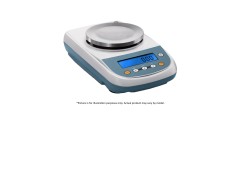
Arlyn High Resolution Balances are designed for lower-capacity laboratory work. Current configurations range from 200 g × 0.1 mg to 6,200 g × 10 mg.
They are suited to controlled applications such as:
- Sample preparation
- Water and environmental testing
- Small formulations
- Quality-control sampling
- Lightweight component measurement
- University research and instruction
RS-232 communication is included. Selected printer and Windows-interface options are available, but the line does not natively offer the same upgrade range as Ultra Precision.
Add UpScale to a High Resolution Balance
When a High Resolution Balance provides the correct capacity and readability but the laboratory needs more advanced data functions, a compatible balance can be connected to the Arlyn UpScale Touchscreen through Third-Party Scale Integration.
Depending on the selected options and compatibility, UpScale may support:
- Touchscreen operation
- Product, sample and operator fields
- User management
- Barcode and QR-code workflows
- Checkweighing
- USB or network-based logging
- Ethernet or Wi-Fi communication
- Google Spreadsheet logging
- Web API access
UpScale expands the workflow, not the measurement performance. The original balance continues to determine capacity, readability, accuracy, repeatability and environmental suitability.
Ultra Precision Scales for Industrial Laboratory Work
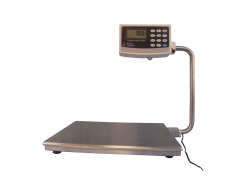
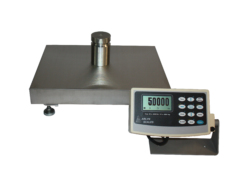
Arlyn Ultra Precision Scales use Surface Acoustic Wave technology to provide fine measurement performance at substantially higher capacities than laboratory-style balances.
They are appropriate when the laboratory needs:
- Industrial bench or platform capacities
- Large sample containers
- Custom platform dimensions
- Greater overload protection
- USB, Ethernet or Wi-Fi
- PLC and industrial-protocol integration
- Setpoints, relays or alarms
- Automated filling or batching
- Multi-scale arrangements
- Approved hazardous-location configurations
Ultra Precision is not automatically the right choice for every small sample. Compare its model-specific readability with that of the High Resolution Balance line.
Control the Laboratory Environment
Fine measurements can be affected by:
- Vibration
- Air currents
- Temperature changes
- Static electricity
- Evaporation
- Moisture absorption
- Off-center loading
- Unstable work surfaces
Install sensitive balances on a rigid, level surface away from doors, fans and vibration-producing equipment. A draft shield can reduce air-current effects but does not replace environmental control or hazardous-material containment.
Calibration and Verification
A factory-calibrated or automatically calibrated instrument still requires an appropriate verification program. The laboratory should define:
- Calibration frequency
- Verification intervals
- Acceptable test weights
- Environmental conditions
- Documentation and traceability
- Actions required when a result is outside tolerance
The required procedure depends on the application, quality system and applicable standards.
Laboratory Balance Selection Checklist
- Maximum gross load
- Minimum meaningful weight change
- Required accuracy and repeatability
- Container and platform dimensions
- Temperature, vibration and air movement
- Chemical and moisture exposure
- Calibration requirements
- Computer, LIMS or network connection
- Operator and sample-identification needs
- Printing, barcode and record-retention requirements
- Automation or control requirements
- Hazardous-area classification, when applicable
Frequently Asked Questions
Should I choose a High Resolution or Ultra Precision scale?
Choose High Resolution for the finest low-capacity readability. Choose Ultra Precision for higher capacity, industrial platforms, customization and broader connectivity or automation.
Can a High Resolution Balance use the UpScale Touchscreen?
A compatible balance can connect to UpScale through Third-Party Scale Integration. Compatibility and required feature modules should be confirmed before ordering.
Does a draft shield improve accuracy?
A draft shield can reduce instability caused by air movement. It does not correct vibration, temperature variation, static electricity, calibration problems or unsuitable sample handling.
Does automatic calibration eliminate verification?
No. Laboratories should still follow an appropriate calibration and verification procedure based on the method, quality system and applicable requirements.
Can laboratory scales connect to a LIMS or network?
Selected configurations support serial, USB, Ethernet, Wi-Fi, API and industrial interfaces. Compatibility with the laboratory’s software and required data format must be confirmed.
Configure a Laboratory Weighing Solution
Browse High Resolution Balances for lower-capacity work or Ultra Precision Scales for configurable industrial precision weighing.
Call 800-645-4301 or contact Arlyn Scales with your load range, required readability, laboratory environment and data requirements.
Related Laboratory & Research Scale Solutions
Explore weighing solutions for laboratories, universities, environmental research, precision measurement, gemstones, and other specialized research applications: