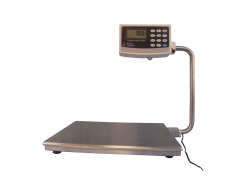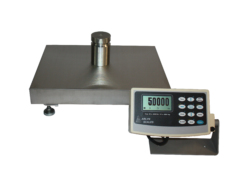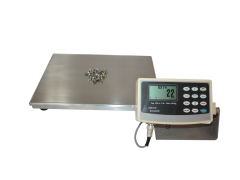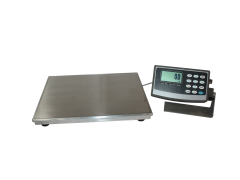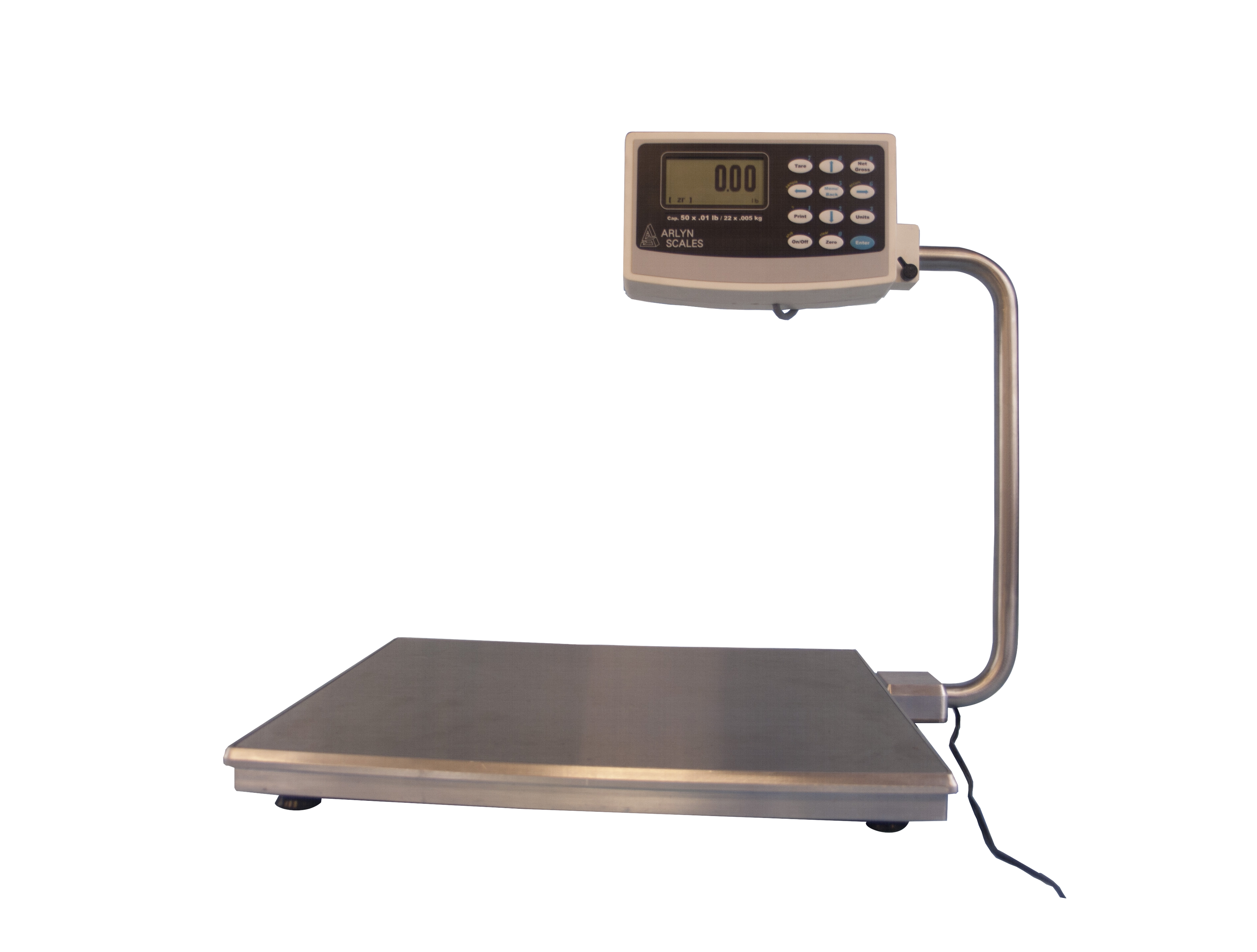
Accurate weighing helps food manufacturers control ingredient usage, maintain consistent batches, verify finished-product quantities and reduce unnecessary material loss. However, accuracy is only one part of choosing the right scale. Buyers must also consider capacity, readability, platform size, cleaning requirements, data collection and whether the installation area has been formally classified as hazardous because of combustible dust.
Quick answer: Choose a food manufacturing scale by matching its capacity, readability and physical design to the weighing task. Confirm that its construction and enclosure are compatible with your cleaning procedures. If combustible flour, sugar, grain, starch or another fine dust is present, use an intrinsically safe scale only when required by the facility’s documented hazardous-area classification—and verify that the exact scale configuration is approved for that classification.
Arlyn Scales offers bench, platform, floor and intrinsically safe weighing systems for different stages of food processing and production. Explore food processing scale solutions, or contact Arlyn Scales for help matching a scale to your application.
Why Accurate Weighing Matters in Food Manufacturing
A weighing error that appears small on a single batch can become expensive when repeated across hundreds or thousands of production cycles. Using a properly selected scale can help manufacturers:
- Control the amount of each ingredient added to a recipe
- Improve consistency between production batches
- Reduce overfilling and unnecessary product giveaway
- Verify incoming materials and finished-product quantities
- Support inventory records, quality procedures and process traceability
- Automate filling, batching or dispensing operations
The scale with the finest displayed increment is not automatically the best choice. A useful scale must provide sufficient capacity for the heaviest expected load—including containers, carts or pallets—while offering readability appropriate for the smallest meaningful change in the process.
Readability, resolution and accuracy are related but are not interchangeable. Readability describes the smallest increment shown by the indicator. Accuracy describes how closely the measured result agrees with the actual value under specified conditions. Buyers should compare complete performance specifications instead of choosing a scale solely by its number of displayed decimal places.
Match the Scale to the Food Weighing Task
Food production may involve small containers of flavoring, large bins of ingredients, drums of liquid, finished cartons or full pallets. The physical scale should fit both the load and the way employees or material-handling equipment will move it.
| Weighing Application | Scale Type to Consider | Important Selection Factors | Product Pathway |
|---|---|---|---|
| Ingredients, containers and production samples | Bench scale | Capacity, required readability, container size and available work-surface space | View industrial bench scales |
| Bins, totes, drums and larger ingredient containers | Low-profile platform scale | Platform dimensions, loading method, ramps, capacity and traffic around the scale | View platform scales |
| Pallets, bulk containers and finished shipments | Floor scale | Maximum loaded weight, pallet dimensions, forklifts, pallet jacks and ramp access | View floor scales |
| Fine formulation or small ingredient changes | Higher-resolution bench or platform scale | Required uncertainty, vibration, drafts, temperature stability and process tolerances | Explore higher-precision options |
| A formally classified area containing combustible dust, gas or vapor | Intrinsically safe bench, platform or floor scale | Exact class, division, zone, group, temperature and complete system approval | View ArlynGuard scales |
This table is a starting point rather than a substitute for reviewing the actual application. Platform dimensions, indicator location, environmental protection, legal-for-trade requirements and integration needs may change the final recommendation.
Consider Cleaning, Moisture and Corrosion
Food production environments vary widely. A scale used to weigh sealed cartons in a dry packaging room faces different conditions from a scale exposed to brine, acidic ingredients, condensation or frequent sanitation procedures.
Stainless steel can provide useful corrosion resistance and easier-to-maintain surfaces, but stainless construction alone does not make an entire scale washdown-rated. The indicator, load cells, cables, connectors and junction areas must also be suitable for the environment.
Before ordering, document:
- The cleaning chemicals used around the scale
- Whether cleaning involves wiping, spray, low-pressure rinsing or high-pressure washdown
- How frequently the scale will be cleaned
- Expected exposure to water, steam, oils, salt, acids or corrosive ingredients
- The enclosure or ingress-protection rating required by the facility
Confirm the approved cleaning method and environmental rating of the exact scale configuration. Do not assume that an exposed scale can tolerate pressure washing simply because its platform or load cells are stainless steel.
When Does Food Dust Require an Intrinsically Safe Scale?
Fine particles from flour, sugar, starch, grain and other food materials can create a combustible-dust hazard when they become suspended in air at a sufficient concentration and encounter an ignition source. However, the presence of one of these ingredients does not automatically mean every part of a food facility is a classified hazardous location.
The facility’s qualified safety and engineering personnel should perform a dust-hazard assessment and determine the electrical area classification. That classification may depend on the material, particle size, concentration, ventilation, housekeeping practices, equipment and likelihood that a hazardous dust cloud or layer will be present.
Important distinction: A standard industrial scale may be appropriate in an ordinary food-production area. An intrinsically safe scale should be selected when the documented hazardous-area classification requires approved equipment.
Review the OSHA combustible-dust guidance and work with the professionals responsible for your facility’s classification. Then verify that the scale indicator, load cells, batteries, barriers and accessories are approved as a complete system for the required location.
ArlynGuard configurations are available in multiple form factors, allowing buyers to match the hazardous-location requirement with the physical weighing task. Battery replacement and charging must be performed in a safe area unless the approved system documentation explicitly permits another procedure.
If you already know the classification of the installation area, send Arlyn Scales the class, division or zone, group and application details so the team can evaluate an appropriate configuration.
Plan for Batching, Records and Process Integration
For many food manufacturers, the weight displayed on the screen is only the beginning. The scale may also need to send readings to a computer, record production data, control filling equipment or communicate with a plant network.
Depending on the scale and indicator configuration, useful options may include:
- Stored tare values for commonly used bins and containers
- Setpoint outputs for filling, dispensing or alarm functions
- USB, Ethernet or Wi-Fi communication
- PLC and industrial-network integration
- Data logging for production and quality records
- Multi-scale or customized weighing arrangements
Define the desired data format, connection type, software destination and control sequence before ordering. Indicator and communication upgrades can make a weighing process easier to operate and document, but they do not by themselves change the inherent accuracy of the scale’s weighing system.
For automated filling and formulation applications, review Arlyn’s batching and process-control options.
Food Manufacturing Scale Buying Checklist
Before requesting a quote, gather the following information:
- Minimum and maximum load: Include the product, container, pallet, cart or other tare weight.
- Required readability and process tolerance: Identify the smallest weight change that matters to the operation.
- Load dimensions: Measure the largest container, tote, drum or pallet.
- Loading method: Note whether employees, carts, dollies, pallet jacks or forklifts will load the scale.
- Environment: Describe temperature changes, vibration, moisture, corrosion and cleaning procedures.
- Hazardous-area classification: Supply the documented class, division or zone and material group when applicable.
- Data requirements: Identify computers, networks, PLCs, printers or software that must receive the readings.
- Control requirements: Describe any filling, batching, alarms or setpoint functions.
- Compliance requirements: State whether the application requires legal-for-trade approval or another industry-specific standard.
Frequently Asked Questions
What type of scale is best for food manufacturing?
The best scale depends on the load and process. Bench scales are commonly used for ingredients and smaller containers, platform scales for bins and drums, and floor scales for pallets or bulk loads. Capacity, readability, cleaning requirements and environmental conditions should determine the final configuration.
Does a food manufacturing scale have to be stainless steel?
Not in every application. Stainless steel is often beneficial where corrosion resistance and easier surface maintenance are priorities. A dry packaging or shipping area may not require the same construction as a wet or corrosive processing area. Stainless steel construction also does not automatically mean that the complete scale is washdown-rated.
Do flour and sugar require an intrinsically safe scale?
Flour, sugar and certain other fine food dusts can be combustible, but their presence does not automatically classify an entire facility. The scale must match the documented electrical area classification established through the facility’s hazard assessment.
What is the difference between readability and accuracy?
Readability is the smallest increment displayed by a scale. Accuracy describes how closely a measurement agrees with the actual value under specified conditions. A display with a small increment does not, by itself, prove that the complete weighing system will meet a process requirement.
Can a food production scale send weights to a computer or PLC?
Yes. Depending on the chosen indicator and options, Arlyn scales can support data collection and process integration through connections such as USB, Ethernet, Wi-Fi and industrial communication interfaces. Compatibility should be confirmed before ordering.
Can an industrial scale control a food batching process?
A scale equipped with suitable setpoint and control options can support filling, dispensing and batching processes. The number of ingredients, valve or relay requirements, target weights and desired sequence should be reviewed when configuring the system.
Find the Right Scale for Your Food Manufacturing Process
A well-selected scale can improve consistency, reduce product loss and make production records easier to maintain. The correct solution should fit the load, provide appropriate measurement performance, tolerate the operating environment and meet any applicable hazardous-location requirements.
Call Arlyn Scales at 800-645-4301 or use the online contact form. Include your load range, required readability, platform dimensions, cleaning procedure, area classification and connectivity needs so the team can recommend an appropriate weighing system.