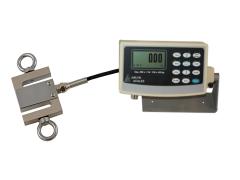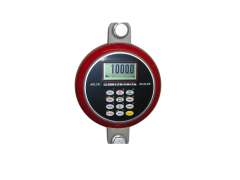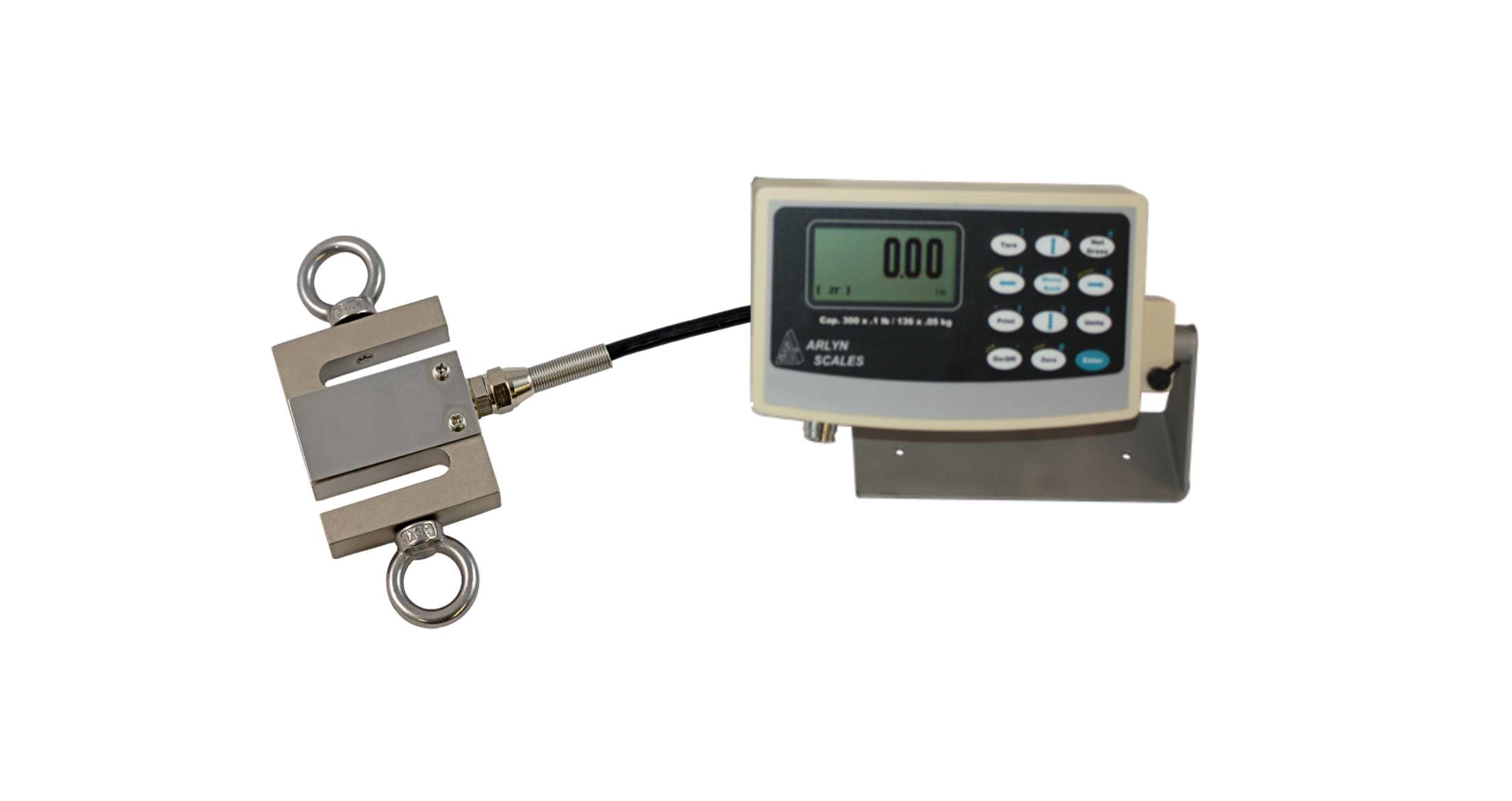
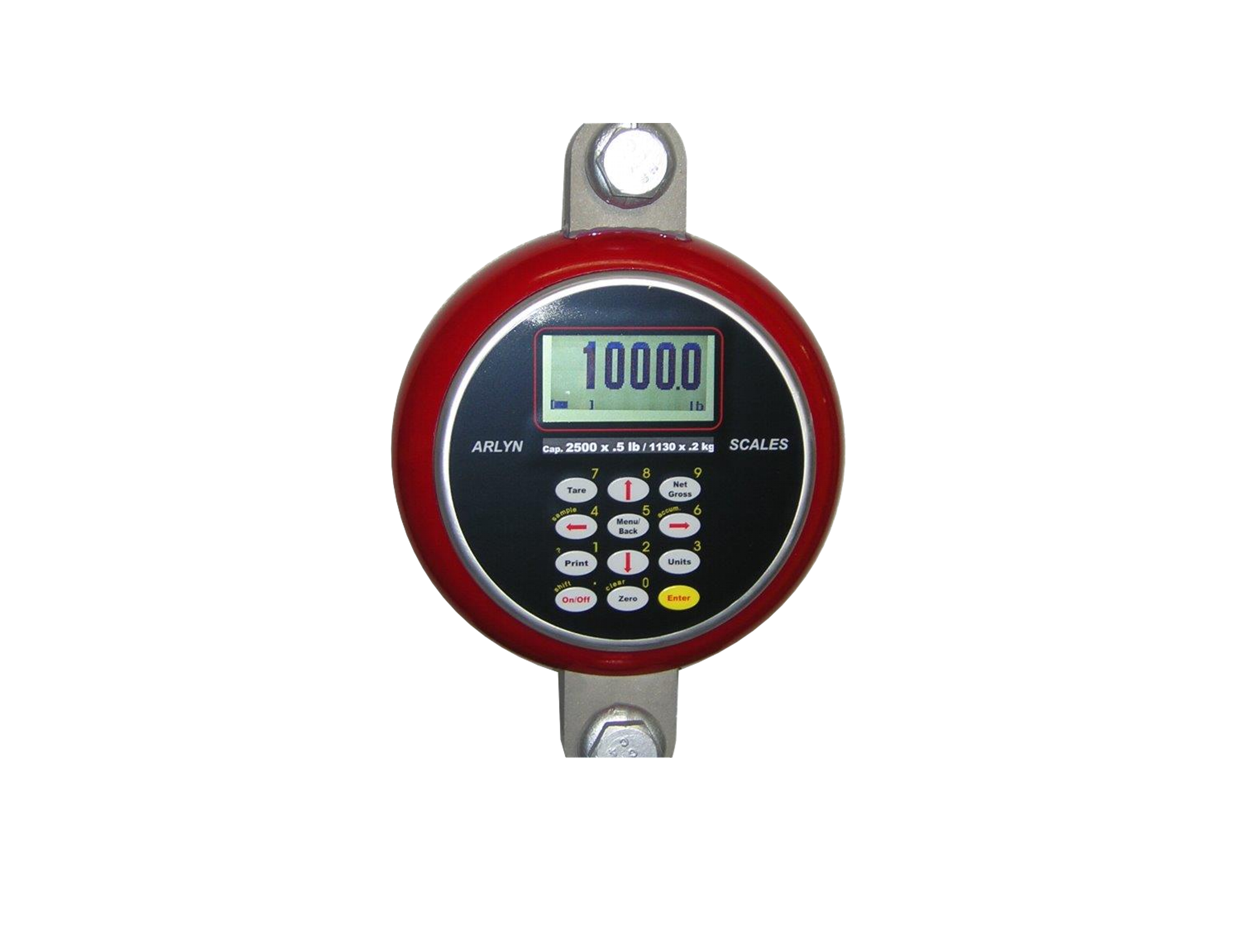
Hanging scales and crane scales both measure suspended loads, but the Arlyn HNG and ARC product families are different weighing systems. The HNG hanging scale is a modular system that connects an S-type load cell to a separate MKE-5 or UpScale indicator. The ARC crane scale is a compact, self-contained instrument with an integrated weight display and rechargeable battery power.
This distinction affects capacity selection, display placement, portability, connectivity, automation and customization. An ARC crane scale can be a strong choice for straightforward suspended weighing with an integrated local display. An HNG hanging scale offers a broader range of capacities and substantially greater flexibility for remote indicators, touchscreen workflows, data collection, industrial communication and custom process integration.
What is the primary difference between an Arlyn hanging scale and an Arlyn crane scale?
Choose an HNG hanging scale when the application requires a separate indicator, wider capacity selection, UpScale touchscreen functionality, communication outputs or process integration. Choose an ARC crane scale when a compact, rechargeable battery-powered, self-contained instrument is more important than extensive customization.
Hanging Scale vs. Crane Scale: Quick Comparison
| Selection Factor | HNG Hanging Scale | ARC Crane Scale |
|---|---|---|
| System architecture | S-type load cell connected to a separate digital indicator | Self-contained load sensor, housing, display and battery-powered instrument |
| Published capacities | 25 to 20,000 lb across multiple standard configurations | 2,500, 5,000 and 10,000 lb |
| Indicator choices | MKE-5 graphic indicator or optional 7-inch UpScale touchscreen | Integrated 1-inch-high LCD weight display |
| Display location | Can be positioned separately from the load cell for convenient access and viewing | Display remains on the suspended scale housing |
| Power | AC power standard; optional 24VDC and battery configurations depend on the selected indicator | Two rechargeable NiMH C-cell batteries |
| Communication potential | Optional RS-232, RS-422/485, USB, Ethernet, Wi-Fi, analog output and other interfaces | More limited configuration focused on self-contained weighing, with selected optional functions |
| Industrial integration | UpScale can support Modbus, EtherNet/IP, PROFINET, REST API access, logging, setpoints and configurable workflows | Set-point and relay options are available, but ARC is not positioned as the same extensively configurable platform |
| Portability | Depends on the selected indicator, power source, mounting and cable arrangement | Integrated design supports portable suspended weighing |
| Best suited for | Custom, fixed, connected or process-integrated suspended weighing | Portable suspended weighing with a self-contained local display |
These distinctions provide a starting point rather than engineering approval for a particular operation. Capacity, attachment geometry, rigging, environmental exposure, cable routing, indicator placement and applicable safety requirements must be evaluated for the complete system.
What Is an HNG Hanging Scale?
The Arlyn HNG hanging scale is built around an S-type load cell. The load cell is installed in the tension load path, while a cable connects it to a separate digital weight indicator. This modular arrangement separates the weighing sensor from the operator interface.
The indicator can be positioned where it is easier for the operator to see, reach and use. Depending on the application, it may be installed on a nearby wall, column, machine frame or control station. The mounting location and cable path must be protected from damage and must not interfere with the load or surrounding equipment.
The HNG scale can be configured with either:
- Arlyn MKE-5 indicator: A pushbutton industrial indicator with a monochrome graphics display, weighing functions, stored tare capabilities and optional communication or control outputs.
- Arlyn UpScale indicator: A 7-inch color touchscreen platform offering expanded workflow customization, data handling, user controls, communication choices and industrial integration.
This modular design is the HNG scale’s principal advantage. The customer is not limited to reading weight from a display incorporated into the suspended sensor. The weighing system can become part of a manufacturing, testing, monitoring, data or process-control workflow when the appropriate configuration is selected.
What Is an ARC Crane Scale?
The Arlyn ARC crane scale combines its stainless steel load sensor, protective housing, digital display and rechargeable batteries into a self-contained instrument. The scale is suspended between suitable overhead lifting equipment and a properly rigged load.
The integrated LCD uses 1-inch-high characters so the weight can be viewed from a distance. Standard functions include pushbutton zero, tare, net and gross weight display, adjustable display response and multiple weighing units. Optional hooks and shackles are available for different attachment requirements.
The ARC configuration is useful when the principal requirement is to lift and obtain a local weight reading without installing a separate indicator, routing a display cable or designing an extensive communication system.
When the HNG Hanging Scale Is the Better Choice
The HNG system is generally the stronger candidate when flexibility, indicator placement and integration are central to the project.
1. You Need a Capacity Outside the ARC Range
The current ARC family is offered in 2,500-, 5,000- and 10,000-pound capacities. The HNG family extends from 25 pounds to 20,000 pounds, providing more choices for lighter suspended measurements and a higher standard maximum capacity.
This broader selection can help match readability more closely to the measuring requirement. Selecting a 10,000-pound scale for a 100-pound load would provide much coarser readability than an appropriately selected lower-capacity HNG model.
2. The Weight Display Must Be Positioned Remotely
A separate indicator can be placed where it is easier for an operator to see and use. This can be valuable when the load cell is installed above eye level, within a machine, beneath a suspended vessel, on a test structure or in another location where an integrated display would be inconvenient.
3. The Scale Must Communicate With Other Systems
Depending on the selected indicator and configuration, the HNG scale can support communication methods such as:
- RS-232 serial communication
- RS-422 or RS-485
- USB communication
- Ethernet TCP/IP
- Wi-Fi with an appropriate UpScale configuration
- Analog output such as 4-20 mA or 0-5 VDC
These options can transmit weight information to a computer, data-acquisition system, compatible controller or industrial network. The correct interface depends on the receiving equipment, protocol, update requirements, cable distance and system architecture.
4. The Application Needs Industrial Protocols or a REST API
With the appropriate UpScale configuration, available interfaces include Modbus RTU/ASCII, Modbus TCP, EtherNet/IP, PROFINET and a REST Web API.
The REST API can allow a compatible software application to request weight information directly from the scale. This creates possibilities for custom databases, production systems, inventory software and specialized software workflows.
Interface availability does not make integration automatic. Network configuration, authentication, data mapping, update behavior, error handling and software development requirements should be reviewed before ordering.
5. Operators Need a Custom Touchscreen Workflow
The optional UpScale touchscreen can provide an interface tailored to the process rather than limiting the operator to a basic weight display. Potential capabilities include customized screen formats, stored tare information, set-point recipes, user-defined fields, data logging, user controls and supported import or export functions.
This is useful when personnel must associate a project, component, batch, test, individual or location with the recorded weight.
6. Weight Must Support a Process Action
Setpoints, relays, alarms and light-tower options can support properly engineered monitoring, filling, batching and process-control applications. For example, a suspended vessel or material container may be monitored as material is added or removed.
These process options must not be confused with lifting-safety controls. A setpoint, relay or scale warning should not be treated as a replacement for required overload protection, lifting controls or engineered safety systems.
7. The Organization Needs Better Weight Records
Depending on the indicator and options selected, the HNG system can support time-and-date output, USB data logging, PC-based remote indicator software, Google Sheets logging, printer output, REST API access and AxChange cloud monitoring.
Automated data collection can reduce manual transcription and associate readings with production, quality-control, inventory, maintenance or operational records.
When the ARC Crane Scale Is the Better Choice
A highly configurable weighing system is not required for every operation. ARC may be the better choice when:
- The expected load fits within a 2,500-, 5,000- or 10,000-pound configuration.
- A self-contained display is visible from the intended operating position.
- Rechargeable battery-powered portability is more important than extensive networking.
- The scale will be moved among appropriate lifting locations.
- The process requires straightforward tare, zero, net/gross and unit-conversion functions.
- The customer prefers an integrated housing instead of a separate load cell, indicator and connecting cable.
- Only selected additional functions, such as counting, time-and-date output or basic set-point control, are required.
Choosing ARC does not mean choosing an inferior weighing instrument. It means selecting a more focused, self-contained architecture for an application that does not need the HNG system’s broader integration potential.
Published Capacity and Readability Options
Readability is the smallest increment shown on the display. It is not the same as accuracy. Both product families currently list accuracy of 0.1% of full scale, while their capacity and readability choices differ significantly.
| Model | Capacity | Readability | Metric Capacity and Readability |
|---|---|---|---|
| HNG-25 | 25 lb | 0.005 lb | 11 kg × 0.002 kg |
| HNG-50 | 50 lb | 0.01 lb | 22 kg × 0.005 kg |
| HNG-100 | 100 lb | 0.02 lb | 45 kg × 0.01 kg |
| HNG-150 | 150 lb | 0.05 lb | 67 kg × 0.02 kg |
| HNG-200 | 200 lb | 0.05 lb | 90 kg × 0.02 kg |
| HNG-250 | 250 lb | 0.05 lb | 113 kg × 0.02 kg |
| HNG-500 | 500 lb | 0.1 lb | 226 kg × 0.05 kg |
| HNG-750 | 750 lb | 0.2 lb | 340 kg × 0.1 kg |
| HNG-1000 | 1,000 lb | 0.2 lb | 453 kg × 0.1 kg |
| HNG-1500 | 1,500 lb | 0.5 lb | 680 kg × 0.2 kg |
| HNG-2000 | 2,000 lb | 0.5 lb | 907 kg × 0.2 kg |
| HNG-2500 | 2,500 lb | 0.5 lb | 1,134 kg × 0.2 kg |
| HNG-5000 | 5,000 lb | 1 lb | 2,260 kg × 0.5 kg |
| HNG-10000 | 10,000 lb | 2 lb | 4,536 kg × 1 kg |
| HNG-20000 | 20,000 lb | 5 lb | 9,072 kg × 2 kg |
| Model | Capacity | Readability | Metric Capacity and Readability |
|---|---|---|---|
| ARC-2500 | 2,500 lb | 0.5 lb | 1,000 kg × 200 g |
| ARC-5000 | 5,000 lb | 1 lb | 2,000 kg × 500 g |
| ARC-10000 | 10,000 lb | 2 lb | 4,000 kg × 1 kg |
Product configurations can change. Confirm current capacity, readability, attachment, power and indicator options when ordering.
Choosing an Indicator for an HNG Hanging Scale
| Requirement | MKE-5 Indicator | UpScale Touchscreen |
|---|---|---|
| Operator interface | Sealed pushbutton keypad with monochrome graphic display | 7-inch color touchscreen with configurable screen formats |
| Stored tares and samples | Up to 100 stored tares or samples | Expanded storage with search and organizational functions |
| Connectivity | Optional RS-232, USB, Ethernet, RS-485 and analog output | Optional RS-232, USB, Ethernet, Wi-Fi, RS-485, analog output and REST API access |
| Industrial protocols | Suitable for standard scale outputs but not the principal choice for advanced protocol integration | Available support for Modbus, EtherNet/IP and PROFINET configurations |
| Data workflows | Optional logging and customizable print output | Expanded logging, custom fields, import/export and configurable print formats |
| Best suited for | Direct industrial weighing with familiar pushbutton operation | Connected weighing, custom workflows, automation and advanced data management |
Review the complete Arlyn indicator comparison when deciding between MKE-5 and UpScale. Communication and software options must be selected as part of the complete scale configuration.
Civil Engineering and Construction Applications
Both product types can support civil engineering and construction-related weighing, but their strengths apply to different situations.
Potential HNG Hanging Scale Applications
- Fabrication measurement stations: Install the S-type load cell as part of a dedicated suspended weighing station and position the indicator at the operator’s workstation.
- Structural-component documentation: Record the measured weight of fabricated assemblies, pipe sections, frames or other suitable components.
- Material-container monitoring: Monitor suitable suspended hoppers, bags, bins or vessels as material is added or removed.
- Engineered test fixtures: Incorporate the load cell into an appropriately designed tension or force-measurement setup.
- Remote data acquisition: Transfer readings to a computer, industrial network or data-logging system.
- Process control: Use configured setpoints, outputs or alarms within a properly engineered manufacturing or material-handling system.
- Touchscreen workflows: Prompt operators to select a project, component, batch or test before recording the weight.
Potential ARC Crane Scale Applications
- Portable suspended weight verification: Move the self-contained scale among appropriate lifting locations.
- Shipping and receiving: Obtain a local weight reading for suitably rigged components or containers.
- Field material handling: Weigh loads where an integrated battery-powered display is more practical than a separate indicator.
- Fabricated-assembly checks: Measure components that fit the published ARC capacities.
- Temporary weighing operations: Use the self-contained unit when permanent data or control integration is unnecessary.
Important Safety and Capacity Distinctions
A hanging scale or crane scale measures an applied suspended load. It does not establish lifting capacity or make an otherwise unsuitable operation permissible.
- Every component in the load path must be appropriate and properly rated for the complete application.
- Gross suspended load includes the object, container, hooks, shackles, slings, spreader beams and other attachments.
- The tare function changes the displayed net weight but does not remove rigging or support-equipment weight from the physical load.
- Acceleration, sudden stopping, swinging, shock and side loading can create forces greater than static weight.
- Do not use a setpoint, relay or overload warning as a substitute for required lifting-safety controls.
- Personnel must not stand or work beneath suspended industrial loads.
- Installation, inspection and operation must follow the equipment instructions, approved procedures and applicable requirements.
Both current product pages identify an overload warning at 102% of scale capacity. That message means the scale has exceeded its rated weighing range. It is not advance overload prevention, additional operating capacity or authorization to continue the operation.
Accuracy, Readability and Stable Measurements
Arlyn currently publishes an accuracy of 0.1% of full scale for both the HNG and ARC families. Accuracy should not be confused with readability:
- Capacity is the maximum load the scale is designed to measure within its published range.
- Readability is the smallest weight increment shown on the display.
- Accuracy describes how closely the measured result is expected to agree with the actual value under defined conditions.
For example, the HNG-100 displays changes in 0.02-pound increments, while the HNG-10000 displays changes in 2-pound increments. Selecting a capacity much higher than the application requires can reduce the usefulness of the displayed measurement.
Suspended loads can also move, swing and vibrate. Readings should be taken after the load stabilizes whenever the approved procedure permits. Applications involving movement, dynamic force or high-speed measurement should be reviewed with Arlyn before the equipment is selected.
How to Choose Between HNG and ARC
Use the following questions to identify the better starting point:
- What is the maximum gross suspended load? Include the load, container and attachment components.
- What is the smallest weight change that must be displayed?
- Should the indicator be attached to the scale or mounted separately?
- Will the scale be portable or installed as part of a fixed process?
- Does the application require AC, DC or rechargeable battery power?
- Must weight data reach a computer, PLC, industrial network, cloud system or healthcare application?
- Are setpoints, relays, alarms, printing, API access or data logging required?
- Would a custom touchscreen workflow reduce operator or transcription errors?
- What temperature, moisture, dust, vibration or chemical exposure will the equipment encounter?
- What load-cell attachments and mounting components are required?
- How much vertical headroom is available?
Need a configurable suspended weighing system?
Start with the HNG hanging scale when indicator placement, capacity flexibility, touchscreen operation, connectivity or industrial integration matters.
View HNG Hanging Scale Models
Discuss a Custom Configuration
Frequently Asked Questions
Are hanging scales and crane scales the same?
Both measure suspended loads, but Arlyn’s HNG and ARC systems have different architectures. HNG uses an S-type load cell connected to a separate MKE-5 or UpScale indicator. ARC is a self-contained, rechargeable battery-powered crane scale with an integrated display.
When should I choose an HNG hanging scale?
Choose HNG when you need a capacity from 25 to 20,000 pounds, a remotely positioned indicator, an UpScale touchscreen, extensive communication options, API access, data logging, industrial protocols, setpoints or a customized workflow.
When should I choose an ARC crane scale?
Choose ARC when the load fits a 2,500-, 5,000- or 10,000-pound configuration and the application benefits from a compact, self-contained, rechargeable battery-powered scale with an integrated local display.
Can an HNG hanging scale use the Arlyn UpScale touchscreen?
Yes. UpScale is an available indicator upgrade for the HNG product family. It provides a 7-inch touchscreen and can support advanced data, communication, REST API, set-point and industrial integration options.
What communication options are available with an HNG scale?
Depending on the selected indicator and configuration, available options include RS-232, RS-422/485, USB, Ethernet, Wi-Fi, analog output, REST API access, Modbus, EtherNet/IP and PROFINET. Confirm the required interface when ordering.
Can an HNG hanging scale connect to a PLC?
Yes. An appropriately configured HNG system can provide industrial communication or analog output for integration with compatible control equipment. The protocol, data mapping, update behavior and fail-safe requirements must be defined for the application.
Does tare remove attachment or rigging weight from the lifting system?
No. Tare removes that weight only from the displayed net result. The hoist, scale and attachment components continue to support the complete gross suspended load.
Does the scale determine whether a crane or hoist can safely support a load?
No. The scale measures the load applied to it. Equipment capacity, attachment ratings, geometry, dynamic forces and the operating procedure must be evaluated separately.
Can a hanging scale be used for civil engineering projects?
Yes, when the complete system is properly selected and engineered. Potential applications include fabricated-component weighing, material-container monitoring, test fixtures, shipping records and process-integrated suspended weighing.
Can setpoints or relays be used as lifting overload protection?
No. Setpoints and relays can support compatible process-control functions, but they do not replace required overload protection, safety controls or an approved operating procedure.
Choose the Suspended Weighing System That Fits the Entire Process
Arlyn Scales can help compare HNG hanging scales and ARC crane scales based on capacity, readability, indicator placement, power, data requirements, integration and operating environment.
Configure an HNG Hanging Scale
Configure an ARC Crane Scale
Contact Arlyn Scales