A battery-operated industrial scale allows employees to weigh products in locations where a wall outlet is unavailable, inconvenient, or unsafe to reach. Instead of moving every item to a permanently installed scale, operators can bring a portable bench or platform scale closer to the work.
Portable scales are useful for warehouses, shipping departments, manufacturing floors, field operations, inventory checks, receiving areas, temporary workstations, and facilities where the weighing location changes throughout the day.
Industrial portability includes more than pocket-size equipment. A portable industrial scale may be a compact bench scale, a low-profile platform scale, or another weighing system equipped with a rechargeable battery and a practical method for moving it between locations.
What is a portable industrial scale?
A portable industrial scale is a battery-powered weighing system designed to be moved between work areas or operated where AC power is unavailable. The scale should combine a suitable platform size, manageable weight, sufficient battery runtime, appropriate capacity, and the durability required for its operating environment.
Battery-Operated Scale Applications
A battery-powered scale is most useful when access to electrical power would otherwise limit where or how weighing can take place.
Common situations include:
- Weighing packages in different shipping or receiving areas
- Performing inventory checks throughout a warehouse
- Moving a scale between production lines or work cells
- Collecting samples or measurements in the field
- Weighing products inside vehicles, trailers, or temporary facilities
- Operating at trade shows, markets, demonstrations, or temporary events
- Using a scale in a location where running an extension cord would create a hazard
- Keeping a scale operational during short power interruptions
Battery operation reduces the distance that products, containers, samples, or employees must travel to complete a weighing task.
Portable Does Not Always Mean Small
The term portable scale is often associated with pocket scales, kitchen scales, or other consumer products. Industrial portability has a broader meaning.
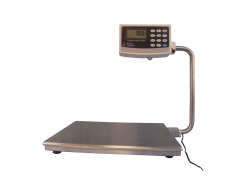
A portable industrial scale may weigh several pounds and still be practical to move between work areas. A larger platform scale may also be considered portable when it has a low-profile frame, a compatible MKE-5 indicator with a rechargeable battery pack, and dimensions that allow it to be transported in a service vehicle or repositioned within a facility.
The correct level of portability depends on:
- How frequently the scale will be moved
- How far it must be transported
- Whether one employee must carry it
- The size and weight of the products being measured
- The available vehicle or storage space
- The surface on which the scale will be used
Portable Bench Scale or Portable Platform Scale
The most important decision is whether the application needs a compact bench scale or a larger, low-profile platform.
| Comparison Point | Portable Bench Scale Compact products and work surfaces |
Portable Platform Scale Larger containers and heavier loads |
|---|---|---|
| Typical product size | Boxes, parts, samples, packages, ingredients, and small containers | Bins, drums, carts, large boxes, vessels, and bulk containers |
| Representative Arlyn capacity | 10 to 150 lb with Series 6200 models | 500 or 1,000 lb with standard Series 3200 models |
| Representative platform | 12 × 16 in stainless-steel weighing surface | 20 × 27 in low-profile platform, with other sizes available |
| Portability | Easier for one person to carry and place on a workbench | Designed to be transported or repositioned, but may require more than one person or material-handling equipment |
| Loading method | Products are normally lifted and placed onto the platform | Low-profile construction makes heavier containers easier to load |
| Best suited for | Portable shipping, parts, sample, and production weighing | Mobile weighing of heavier or physically larger products |
Arlyn Series 6200 Portable Bench Scales
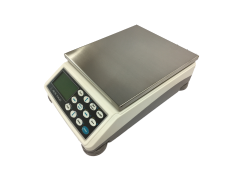
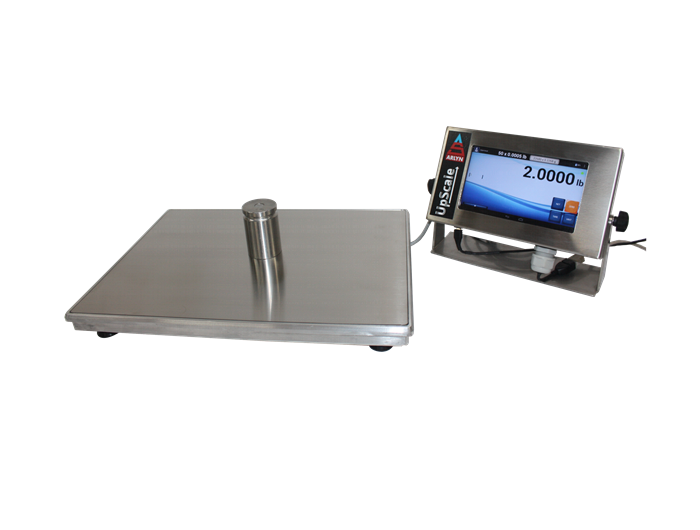
The Arlyn Series 6200 is designed for industrial bench-scale applications requiring a compact platform and a separate digital indicator.
Standard models provide capacities from 10 to 150 lb on a 12 × 16 in stainless-steel platform. The scale uses industrial stainless-steel load-cell construction and is intended for production, shipping, inventory, parts, and general-purpose weighing.
The optional rechargeable battery is available with the MKE-5 indicator. A typical single-load-cell system can operate for approximately 15 to 20 hours, although runtime decreases when additional power-consuming options are installed.
| Model | Capacity | Readability | Platform Size |
|---|---|---|---|
| 620X | 10 lb | 0.002 lb | 12 × 16 in |
| 620T | 25 lb | 0.005 lb | 12 × 16 in |
| 620L | 50 lb | 0.01 lb | 12 × 16 in |
| 620C | 100 lb | 0.02 lb | 12 × 16 in |
| 620F | 150 lb | 0.05 lb | 12 × 16 in |
The best model is normally the one with the lowest capacity that safely supports the heaviest expected product. Choosing a capacity far above the actual load can result in larger displayed increments than the application requires.
Arlyn Series 3200 Low-Profile Portable Platform Scales
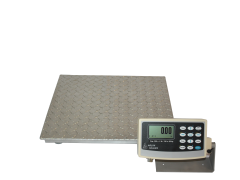
Some portable applications involve loads that are too heavy or physically large for a bench scale. The Arlyn Series 3200 Platform Scale provides a low-profile platform for these situations.
Standard models include 500 and 1,000 lb capacities. The commonly used 20 × 27 in platform is approximately 1.875 in high, helping operators load large boxes, containers, and other heavy products without lifting them onto a tall scale base.
The platform is available in aluminum or stainless steel. Aluminum reduces the overall weight when portability is the priority. Stainless steel may be more appropriate when the scale will be exposed to moisture, cleaning procedures, or corrosive conditions.
With the MKE-5 indicator and optional rechargeable battery, a Series 3200 platform scale can operate away from AC power. Because the platform uses four load cells, expected battery runtime is generally shorter than it is on a single-load-cell bench scale.
Need to weigh heavier products away from an outlet?
A low-profile platform scale may provide a better solution than a compact bench scale when the product weighs several hundred pounds or requires a larger support surface.
Portable Industrial Scale Battery Runtime
Battery runtime depends on the indicator, number of load cells, installed communication options, display usage, battery condition, and ambient temperature.
For Arlyn scales equipped with the optional MKE-5 battery pack, representative operating times are:
- Approximately 15 to 20 hours for many single-load-cell systems
- Approximately 6 to 8 hours for four-load-cell systems
- Approximately 3 to 5 hours when additional power-consuming options are installed
These figures should be treated as operating estimates rather than guaranteed runtime. Batteries gradually lose capacity with age, and frequent communication activity or accessory use can reduce the available operating period.
Rechargeable Scale Battery Maintenance
- Charge the battery before taking the scale into the field.
- Turn the indicator off when the scale is not being used.
- Do not store the system for extended periods with a fully discharged battery.
- Follow the charging instructions supplied with the indicator.
- Periodically test runtime before relying on the scale for a full shift.
- Replace an aging battery when its operating time becomes inadequate.
Portable Industrial Scale Selection Features
Appropriate Capacity and Readability
A portable scale must support the full product weight while displaying increments fine enough for the application. Portability does not compensate for choosing the wrong capacity or readability.
Manageable Size and Weight
Consider who will move the scale and how often. A scale that can technically be transported may still be impractical if it is too heavy for the available employees or vehicle.
Stable Installation
A portable scale still requires a firm and level surface. Soft soil, uneven concrete, unstable tables, vibration, or a rocking platform can reduce repeatability.
A properly designed battery power system should not reduce the scale’s specified accuracy. Low battery condition, installation, calibration, temperature, vibration, load placement, and mechanical interference can still affect weighing results.
Durable Construction
Moving a scale exposes it to impacts and handling that a permanently installed system may not experience. Look for a protected load cell, strong platform, suitable enclosure, and adequate overload protection.
Suitable Environmental Protection
A molded indicator enclosure may be appropriate for general indoor use, while stainless-steel construction may be preferable for wet, corrosive, or regularly cleaned environments.
Offline Data Collection
A field scale may not have access to Ethernet or Wi-Fi. Optional USB flash-drive data logging can allow operators to collect weight records locally and transfer them to a computer later.
Portable High-Resolution and Ultra Precision Scales
Yes. A high-resolution or Ultra Precision Scale can be equipped for battery operation when the selected platform and indicator support the required option.
However, precision measurements are more sensitive to installation conditions. Moving a high-resolution scale between locations may expose it to:
- Temperature changes
- Vibration during transport
- Uneven work surfaces
- Air currents
- Mechanical contact with nearby objects
Allow the scale to stabilize after moving it, confirm that it is level, and verify calibration when the required measurement tolerance is especially tight.
Battery-Powered Scales for Hazardous Locations
Yes, but a standard battery-operated scale must not be assumed safe for a hazardous or classified location.
ArlynGuard intrinsically safe systems are designed for specified hazardous-location classifications and use approved battery-powered indicators. The complete scale, indicator, battery system, wiring, accessories, and installation must comply with the applicable approval and control drawings.
Do not add an ordinary battery pack or unapproved electrical accessory to a scale used in a classified area.
How to Choose a Portable Industrial Scale
Before selecting a scale, determine:
- Maximum load: Include the product, container, pallet, fixture, or support structure.
- Required readability: Identify the smallest weight change the process must detect.
- Platform size: Make sure the entire load can be supported safely.
- Movement frequency: Decide whether the scale will move occasionally or several times each day.
- Expected operating time: Estimate how many hours the scale must run between charges.
- Environment: Consider moisture, corrosion, temperature, vibration, and hazardous-location requirements.
- Data requirements: Determine whether operators need a display only, printed records, USB logging, or another output.
- Loading method: Consider how employees will place heavy or awkward products on the platform.
Find the Right Battery-Operated Industrial Scale
Arlyn Scales can help determine whether your application requires a portable bench scale, a low-profile platform scale, a high-resolution model, or an approved intrinsically safe system.
Call 800-645-4301 with your capacity, platform-size, runtime, and operating-environment requirements.