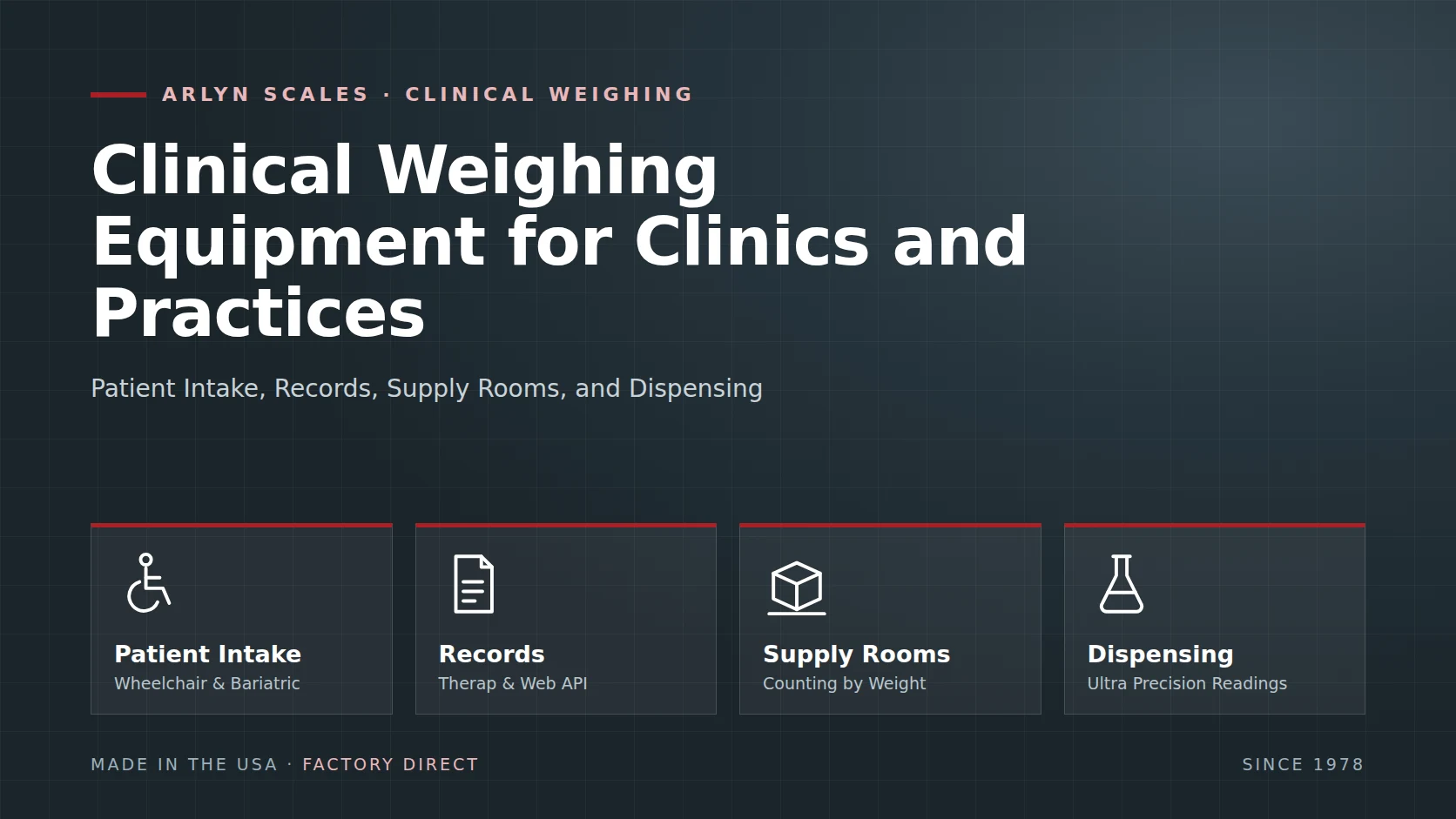
For clinics and physician practices, Arlyn offers a portable wheelchair scale with Therap connectivity, counting and bench scales for supply rooms, and Ultra Precision scales for in-office dispensing.
Clinics, physician practices, therapy centers, and residential care programs weigh patients, supplies, and dispensed materials in smaller spaces than a hospital, often with one scale shared between rooms.
Arlyn has designed and manufactured weighing equipment in the United States since 1978 and sells it factory direct. For hospital-wide needs such as receiving docks, laundries, and gas cylinders, see medical scales for hospitals and medical facilities.
Choose Clinical Weighing Equipment by Setting
Start with the room and what the scale will weigh. A patient weight belongs in a chart, a supply count drives reordering, and a dispensed amount must meet a tight tolerance, so each setting leads to a different scale family.
| Setting | What you weigh | Selection focus | Starting route |
|---|---|---|---|
| Intake and exam rooms | Patients who use wheelchairs | Ramp access, room-to-room portability, and a records connection | Portable wheelchair scale |
| Residential and day programs | Routine resident weights documented in Therap | Therap Connect collection and one scale shared across rooms | Therap-connected wheelchair scale |
| Bariatric care | Combined patient and chair weight | Complete patient-and-chair load, platform dimensions, and ramp access | Bariatric patient scales |
| Supply room | Consumables, kits, and incoming cases | Counting by weight, bench space, and reorder checks | Counting scales or bench scales |
| In-office dispensing | Dispensed and compounded materials | Finer readability at practical bench capacities | Ultra Precision scales |
| Linen and waste | Linen bags and regulated waste containers | Container weight, footprint, and pickup records | Platform scales |
Size the Equipment to the Full Load
Capacity must cover the complete loaded weight: the patient and wheelchair, the bin and its heaviest contents, or the container and its fill. Taring shows net weight but does not restore capacity used by the chair or container. Leave a working margin within the selected model’s rating.
Example: A 350 lb patient and a 60 lb wheelchair place 410 lb on the scale. Taring the chair displays 350 lb while the scale still carries 410 lb.
- Readability and accuracy: Readability is the smallest displayed increment. For dispensing, use the smallest amount weighed and its permitted error to select the required readability and accuracy.
- Platform and loading: A wheelchair needs usable platform space and ramp access. Bench scales suit trays and kits. Check the scale’s footprint against the room, doorways, and the route between weighing locations.
Patient Weighing in Clinics and Care Programs
The portable wheelchair scale weighs the patient and chair together up to 500 lb, with 0.1 lb readability on a 30 × 32 inch platform. Its low-profile ramps allow roll-on access without transferring the patient. Fold-up handrails steady standing patients, and locking casters allow movement between rooms.
A 7-inch touchscreen shows the reading. Wi-Fi connectivity supports collection through the Therap Connect Mobile App and the application integration route described below.
Weigh on a firm, level floor. Our guide to patient and wheelchair weighing systems covers access and setup in more detail. If the complete load exceeds 500 lb or needs different platform dimensions, explore bariatric and specialized patient scales.
Supply Rooms, Dispensing, and Samples
Supply-room inventory and dispensing have different weighing requirements. Counting depends on consistent item weights and a representative sample. Dispensing depends on the smallest amount weighed, the permitted error, and the container weight. Select the scale around the actual task, then use the corresponding product route below.
- Counting consumables: Counting scales tally gloves, syringes, and other consumables by weight. Count one item type at a time, using a representative sample to establish its average piece weight. Re-sample when the item or its packaging changes.
- Receiving and preparing kits: Bench scales handle incoming cases, kits, and outgoing shipments. Include the tray, box, or container in the complete loaded weight.
- In-office dispensing: Ultra Precision scales for medical dispensaries use Arlyn Surface Acoustic Wave (SAW) technology to deliver fine readings at practical bench capacities when a general bench scale’s readability is insufficient.
- Small samples: For lower-capacity milligram or submilligram samples in controlled conditions, explore High Resolution Balances. In-house labs can compare the broader options on the laboratory and research scales hub.
Cleaning and Construction
Scale construction should match the cleaning method and chemicals used in each room. Surface wiping and washdown place different demands on the platform and indicator. For routine disinfectant exposure or wet cleaning, explore corrosion-resistant configurations and their specified materials and enclosure protection.
Clinical Records, Printing, and Facility Controls
Choose the connection by the destination of the reading. Therap collection and application integration support patient records, while computer logging and printed labels serve other clinic workflows. A PLC or facility controller can use a selected analog output. These functions depend on the indicator and communication options included in the scale configuration.
- Therap records: Users of the configured wheelchair scale can collect readings through the Therap Connect Mobile App and send them to Therap Connect and Therap Services Health Tracking.
- EHR or patient-software integration: Patient software or an integration service retrieves the current reading through the scale’s built-in REST Web API. The software must implement that API connection. The UpScale API reference documents weight retrieval.
- Computer records: Select the communication and logging options for the PC or database workflow. Network connectivity, computer communication, and USB flash-drive export serve different functions.
- Printed labels: An UpScale indicator with the Barcode & QR Print Function can send weight and record fields to the Arlyn PR-A90, for example on a kit or a waste container.
- Facility controls: Scalable 4–20 mA analog output can represent weight to a compatible PLC or facility-control input. Match the selected output range to the controller’s configured weighing range.
Frequently Asked Questions
Does the wheelchair scale’s 500 lb capacity include the wheelchair?
Yes. Arlyn’s 500 lb wheelchair scale has a 500 lb limit for the complete patient-and-chair load, including accessories. Taring the chair displays the patient’s net weight while the full load remains on the platform. Allow a working margin when selecting the scale’s capacity.
Can clinical scales send weights to Therap or an EHR?
Arlyn’s Therap-configured wheelchair scale sends readings through the Therap Connect Mobile App to Therap Connect and Therap Services Health Tracking. For an EHR or other patient software, its REST Web API lets the receiving software request the current weight. That software or an integration service must implement the API connection.
When should a clinic choose Ultra Precision scales versus High Resolution Balances?
Choose Ultra Precision scales when dispensing needs fine readings at practical bench capacities or when larger loads and platform sizes matter. High Resolution Balances suit lower-capacity milligram or submilligram samples in controlled conditions. Base the choice on the smallest amount weighed, its permitted measurement error, and the complete loaded weight.
Discuss your clinical weighing application
Tell us the setting, what you weigh, the heaviest loaded weight, the required displayed increment, and where the reading needs to go. Arlyn can recommend a standard scale or build a configuration around the equipment your clinic already uses.
Contact Arlyn ScalesCall 800-645-4301