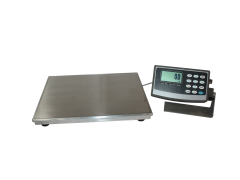
Industrial Bench Scales with Strain Gauge Technology
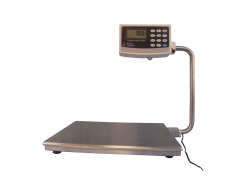
Starting at $594
Industrial bench scales provide a compact weighing station for containers, ingredients, parcels, components and production samples. A user-friendly bench scale should do more than display a weight. It should fit the load, present the necessary functions clearly, position the indicator where the operator can use it and move data into the required workflow without unnecessary manual steps.
Arlyn bench scales are available in standard strain-gauge, higher-readability, Ultra Precision and intrinsically safe configurations. The appropriate model depends on capacity, required measurement performance, environment and integration requirements.
A bench scale is a compact industrial weighing system intended for use on a workbench, table, stand or other suitable support. It generally includes:
Bench scales are commonly used for:
The compact format makes a bench scale useful at individual workstations, but the scale must still be selected for industrial loading, environmental and measurement requirements.
Ease of use is not determined by one feature. It results from matching the scale to the operator and process.
| Feature | Operator benefit | What to verify |
|---|---|---|
| Clear display | Weight and status information can be read without hesitation. | Viewing distance, lighting and whether containers obscure the indicator |
| Accessible controls | Zero, tare, print and other frequent functions remain easy to reach. | Indicator mounting, glove use and operator position |
| Appropriate platform | Containers sit securely without touching the display or surrounding surfaces. | Load dimensions, contact points and center of gravity |
| Stable measurements | Operators can capture results without repeated repositioning or waiting. | Vibration, filtering, installation and required sensitivity |
| Stored values and modes | Repeated tare, counting or process values can be recalled consistently. | Which values operators actually need and who maintains them |
| Data transfer | Weight results can enter another system without handwritten transcription. | Receiving software, protocol, format and trigger method |
| Application fit | The scale supports the complete task with minimal unnecessary steps. | Capacity, performance, environment, controls and data as one system |
Maximum capacity must include everything placed on the scale, not only the product.
Calculate:
A container weighing 8 pounds and holding 40 pounds of product creates a 48-pound gross load. The scale must support the complete load even if the operator uses tare to display only the net product weight.
Do not select excessive capacity without a defined need. Higher capacity may provide coarser displayed increments than a lower-capacity model.
The smallest displayed increment should be fine enough for the decision the operator must make.
Ask:
More displayed decimal places do not automatically improve the result. Measurement technology, calibration, installation and environmental stability must also support the required performance.
| Configuration | Best suited for | Primary reason to select it |
|---|---|---|
| Standard Series 6200 | General production, packaging, shipping and container weighing | Economical industrial weighing when standard performance meets the tolerance |
| Higher-readability configuration | Processes needing a moderate improvement over standard displayed increments | Adds measurement capability without automatically moving to the most specialized system |
| Ultra Precision SAW | Tight-tolerance formulation, finer parts counting and controlled material additions | Provides finer industrial measurement performance when standard technology is insufficient |
| ArlynGuard B | Approved classified hazardous locations | Uses an intrinsically safe system appropriate for specified hazardous-area classifications |
| Selection rule | Choose the least complex configuration that satisfies the documented capacity, tolerance, environment and workflow. | |
A standard strain-gauge bench scale is suitable for many applications, including:
Standard models should be the starting point when their capacity, resolution and accuracy already satisfy the process. Additional sensitivity does not create value when it does not affect a production, inventory or quality decision.
View current industrial bench-scale models and configurations.
An Ultra Precision bench scale should be considered when a standard model cannot provide sufficiently fine measurement performance at the required capacity.
Possible applications include:
Ultra Precision technology should be selected from the documented process requirement, not from a general preference for more decimal places.
Environmental conditions become increasingly important as measurements become more sensitive. Vibration, drafts, mounting, temperature changes and operator technique can affect real-world performance.
Compare current Ultra Precision scale models when standard bench-scale performance is insufficient.
Facilities containing potentially flammable gases, vapors, dusts or fibers may require approved intrinsically safe weighing equipment.
An ordinary bench scale must not be used in a classified location simply because its capacity and platform dimensions fit the load.
Before selecting an ArlynGuard B configuration, confirm:
The scale, indicator, power components and connections must be evaluated as a complete approved system.
Review intrinsically safe scale configurations for classified environments.
The weighing platform must support the container or item securely without allowing it to touch the indicator, workbench, wall or nearby equipment.
Measure:
An object may overhang the platform if it remains stable, transfers its full weight through the scale and does not contact another surface. A larger or custom platform may be appropriate when normal loads cannot be positioned consistently.
Containers, bags and boxes can obscure an indicator mounted too close to the platform. The operator should be able to view and use the display without reaching over the load or working in an awkward position.
Depending on the selected configuration, the indicator may be:
Also consider:
A properly positioned basic indicator may be easier to use than a more advanced interface placed poorly.
The indicator should match the workflow.
| Decision factor | MKE-5 indicator | UpScale touchscreen |
|---|---|---|
| Best fit | Straightforward weighing and push-button operation | Visual workflows, advanced data and expanded integration |
| Operator interface | Physical buttons and graphical LCD | Color touchscreen with configurable functions |
| Typical workflow | Zero, tare, units, gross/net, counting and set points | Guided processes, barcode, advanced logging and industrial communication |
| Budget approach | Use when direct controls satisfy the application. | Select when advanced functions reduce work or enable a required system. |
| Best-value rule | Choose the interface that makes the required task clear and repeatable without adding unused complexity. | |
Tare removes the displayed weight of a container, tray or fixture so the operator can view the net weight of the material.
A typical process is:
Stored tare values can simplify repeated work with known containers. The organization should control how these values are created, identified and updated so an incorrect tare is not applied to the wrong container.
A compatible bench scale can estimate the number of substantially identical pieces by dividing net weight by an established average piece weight.
Counting accuracy depends on:
Light or high-value parts may justify an Ultra Precision configuration. Counting by weight verifies quantity efficiently, but it does not inspect each component for identity or quality.
Bench scales may support workflows in which weight is compared with a target or used to operate other equipment.
Applications can include:
Define the target, tolerance, output, controlled equipment and fail-safe behavior before ordering. A standard scale output should be incorporated into an appropriately engineered control system.
Electronic data transfer can improve ease of use by eliminating handwritten records and repeated typing.
Depending on the scale and indicator, available options may include:
Before selecting an interface, document the receiving device, protocol, data format and operator trigger. A connector alone does not guarantee compatibility.
Review current scale options and communication methods.
A bench scale used in a clean shipping department does not face the same conditions as one used around chemicals, moisture or repeated cleaning.
Document:
A stainless steel platform does not automatically make the complete scale washdown-rated, sanitary, corrosion-proof or intrinsically safe. The frame, load cell, indicator, cables, connectors and enclosure must also be suitable for the environment.
Even a correctly specified scale can perform poorly when installed incorrectly.
Use a support surface that is:
For sensitive measurements, also consider drafts, fans, doors, temperature changes and nearby machinery. Check the scale after relocation or changes to the workstation.
Provide the following information when selecting a bench scale:
A user-friendly bench scale is one that makes the required measurement clear, repeatable and easy to act upon.
The best configuration may be a standard Series 6200 scale with an MKE-5 indicator. A tighter-tolerance process may require Ultra Precision technology. A more complex workflow may justify the UpScale touchscreen, electronic data collection or set-point control. Hazardous locations require a separately approved intrinsically safe configuration.
A user-friendly bench scale has a suitable platform, readable indicator, accessible controls, stable measurements and functions that match the operator’s task. Proper indicator placement and direct data transfer can be as important as the menu design.
Add the heaviest material to every container, tray, fixture or other item supported by the scale. Include reasonable normal variation without purchasing excessive unused capacity.
Choose Ultra Precision technology when a standard industrial bench scale cannot provide the resolution or accuracy required at the needed capacity. Confirm the process tolerance and environmental conditions before selecting it.
The MKE-5 provides direct push-button operation with a graphical LCD. UpScale adds a color touchscreen and broader configurable workflow, data and integration functions. Select the indicator according to the work operators must perform.
Compatible configurations can estimate quantity from average piece weight. Results depend on part consistency, representative sampling, correct tare and sufficient scale resolution relative to the weight of one piece.
A bench scale with compatible set-point and output hardware can support filling by operating pumps, feeders, valves, relays or alerts. The complete control sequence and safety requirements must be engineered for the application.
Yes, depending on the indicator and selected options. Potential interfaces include serial communication, USB, Ethernet, Wi-Fi, analog output and compatible industrial protocols. Confirm the receiving system and data format before ordering.
No, not merely because its capacity fits the application. Classified locations may require an approved intrinsically safe scale system selected for the applicable class, division, group or zone.
Arlyn Scales sells rugged industrial bench scales to match each and every job. Their scales carefully balance the needs for durability and reliability with the imperative to get the highest accuracy and the most for the userÕs money. Industrial scales are specialized machinery with the primary purpose of accurately reporting weight. The weighing technology utilized … Continued
The need to know weight information is pervasive throughout virtually every industrial application. Every company has items they need to ship. They may employ a simple bench scale to determine the weight of packages that are being sent by mail, or by some other parcel service. For heavier items, platform scales are used to weigh … Continued
Bench scales are the workhorses of the weighing industry. A bench scale can be used for a variety of tasks such as packaging, parts counting, food portion control, and many other duties. The space efficient and compact design allows it to be used in a variety of environments. With the right technology inside the scale, … Continued
The digital bench scale has become one of the most popular types of weighing equipment on the market. Our offerings go above and beyond to improve performance and provide superb quality. This device is manufactured under strict regulations to ensure quality. This type of scale is widely used in many industries. Naturally, that’s helped to … Continued
Table of Contents Why Use a Scale Instead of a Flow Meter? How It Works: Weight-Based Flow Tracking Scale Types That Work for Flow Monitoring Where This Fits Automate the Flow (Or Stop It) Connection Options Frequently Asked Questions Let’s Get Your Flow Under Control If you’re handling chemicals, dosing additives, or running any process … Continued
Many industries have use for industrial bench scales. These scales are designed to be more sturdy than smaller scales, because they are designed to hold more weight. These scales vary in features, depending on which type of industry they may be designed for. For normal household use, scales do not have to be as sturdy. … Continued
Think for a moment that you’re a consumer as opposed to a producer. After all, everyone is a consumer of goods at some point since they need to purchase food and other necessities to live. Those who have to buy things will want to check and make sure they’re getting the right amount of product … Continued
When a consumer purchases a container of material, they want to be absolutely sure that the correct amount of material is actually in the container. When a manufacturer fills that container, they also want to be absolutely sure that they have filled the container properly. If they have not filled it with enough material, they … Continued
Copyright © 2007-2026 Circuits & Systems Inc. Arlyn Scales. All Rights Reserved.